Dolphin Sigma
$2999 $2349 SALE Save $650
Temporarily out of stock


By feature
Top pick: Dolphin Sigma
$2349 today · Free shipping
An active brush scrubs because it turns faster than the robot travels, and how each Dolphin gets its scrubbing, by speed or by brush count, decides which one fits your surface.
The short answer
The Dolphin Sigma puts more brush work into each pass than any other robot here, with four scrubbing brushes and three motors behind them. If you want the textbook active brush, choose the Quantum, whose dual HyperBrush rollers spin at twice the speed of standard brushes. The Premier scrubs with two brushes over a long cycle, and the Cayman puts one HyperBrush in pools up to 33 ft.
A brush that turns at the same speed the robot travels is a roller. It lays its bristles on the floor and lifts them off again without sliding, which disturbs loose dust and little else. An active brush is driven faster than the machine moves, so its surface drags across the pool's surface and scrubs. That is the difference people mean when they look for the best robotic pool cleaner with active brushes.
Dolphin's name for a fast-driven brush is HyperBrush, spinning at twice the speed of standard brushes. Three of the five Dolphins compared here use it. The Sigma and Premier take a second route to the same end, more scrubbing brushes instead of a faster one, and we rank four robots below with that distinction kept clear. The label matters less than how much scrubbing reaches your walls.
The ranking
$2999 $2349 SALE Save $650
Temporarily out of stock
Most scrubbing per pass: quad brushes
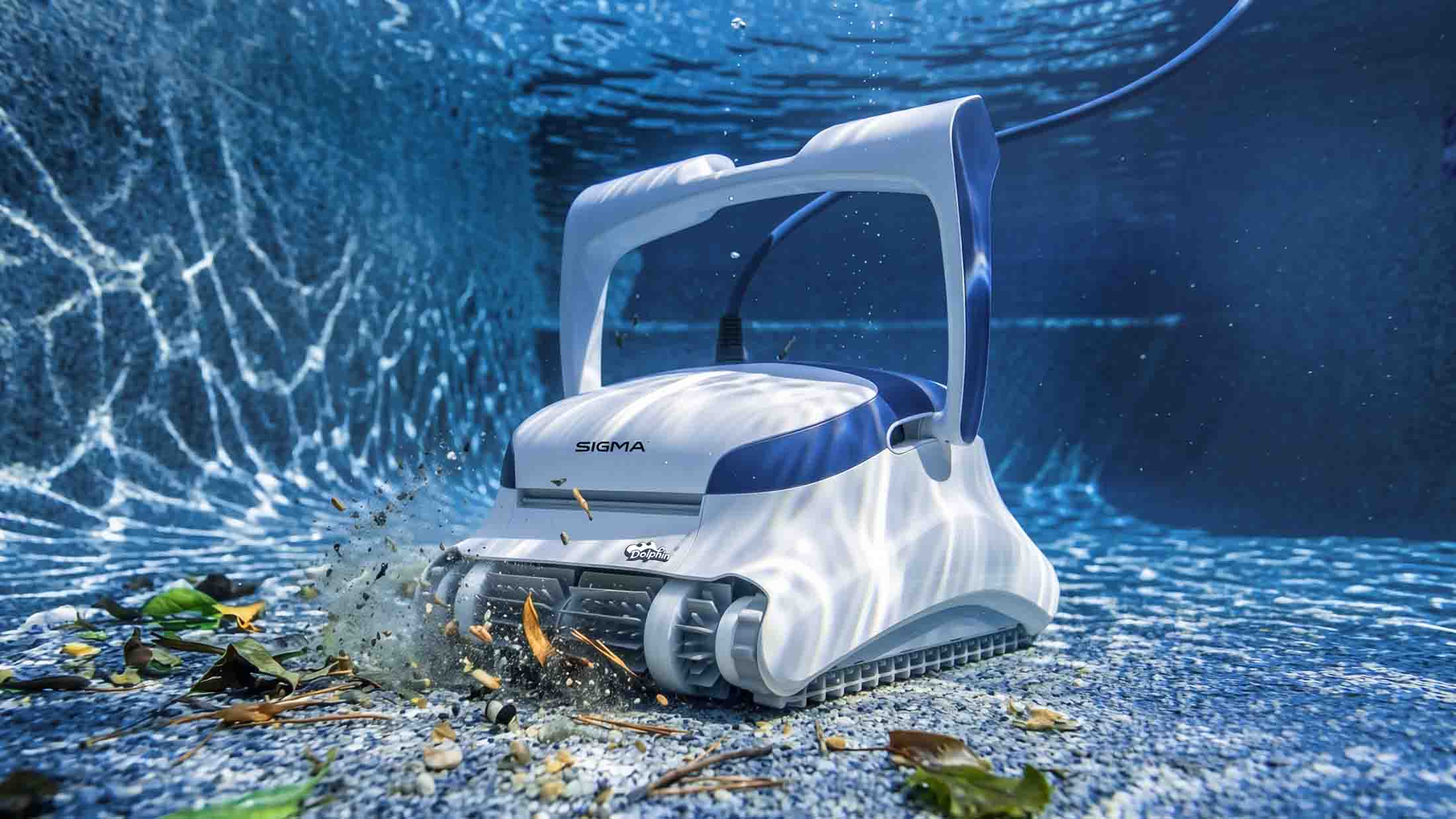
The Sigma leads on total brush work. Its quad scrubbing brushes are not HyperBrush rollers and we quote no spin multiple for them; what they offer is four brushes crossing every strip of surface where the others bring one or two. The flow behind them is 4,500 GPH from three ProLine motors, enough to keep the robot pressed to a wall while NanoFilter cartridges take in the film it lifts. SmartNav 3.0 with an onboard gyroscope spaces the passes evenly, so no section is scrubbed twice while another is skipped.

$1799 $1599 SALE Save $200
Temporarily out of stock
The textbook active brush, times two
By the strict definition, the Quantum is the active-brush robot of the group. It carries dual HyperBrush rollers, each spinning at twice the speed of standard brushes, so a fast brush leads the robot in both directions. That speed is useful on pebble, where film sits in the low spots between stones, and on the waterline band. The Quantum also takes its brushes where the others do not publish coverage: sun shelves, Baja ledges and stairs. NanoFilter panels are included, on the lowest-priced 50 ft robot here.

$2499 $1949 SALE Save $550
Temporarily out of stock
Two scrubbing brushes, three-hour cycle
The Premier uses dual scrubbing brushes. Like the Sigma's, they are not HyperBrush rollers, so its case rests on time and flow instead of spin speed. A 3-hour cycle is the longest of the robots in this guide, which means more passes over the same surface, and dual commercial-grade ProLine motors supply 4,500 GPH to keep it planted on walls and at the waterline. The Multi-Media system includes NanoFilters for the film it lifts and an oversized leaf bag for days when debris, not film, is the job.

$1299 $1049 SALE Save $250
Temporarily out of stock
One HyperBrush for pools up to 33 ft
The Cayman brings the fast brush down in size and price. Its single HyperBrush spins at twice the speed of standard Dolphin brushes, the same principle as the Quantum's pair, on a 14.6 lb robot rated for in-ground and above-ground pools up to 33 ft. Dual 24-volt DC motors move over 4,000 GPH into a MaxBin basket in a 2-hour cycle. One brush gives less contact than a pair, and the Cayman covers floor and walls but not the waterline, so the oily band at the surface is left to a hand brush. Within those limits it is a genuine active-brush robot.
The criteria
Scrubbing is relative motion. The faster a brush turns compared with the robot's travel, the more times each bristle wipes a given spot. HyperBrush rollers turn at twice the speed of standard brushes, the plainest measure of an active brush you will find on a spec sheet.
A second or fourth brush multiplies contact the other way: more brushes cross each strip of surface per pass. The Sigma's four scrubbing brushes and the Premier's two work on this principle.
A brush only scrubs if it is pressed down. On walls that pressure comes from the tracks and from the water the robot moves. Strong flow and good traction turn brush speed into real work, most of all near the top of a wall.
Scrubbing puts film into suspension as a fine cloud. If the filter is too coarse, the cloud settles again an hour later. Judge any brush together with the robot's fine filtration: NanoFilters are included on some of these models and optional on others.
On paper
| Specification | Dolphin Sigma | Dolphin Quantum | Dolphin Premier | Dolphin Cayman |
|---|---|---|---|---|
| Price today | $2349 | $1599 | $1949 | $1049 |
| Cleans | Floor, walls and waterline | Floor, walls, waterline, sun shelves and stairs | Floor, walls and waterline | Floor and walls |
| Scheduling | Weekly scheduler by day and time | Weekly timer: every day, every 2 days or every 3 days | Weekly timer: every day, every 2 days or every 3 days | Timer: every day |
| App | myDolphin Plus (Wi-Fi and Bluetooth) | myDolphin Plus (Wi-Fi) | No app; controls on the power supply | No app; controls on the power supply |
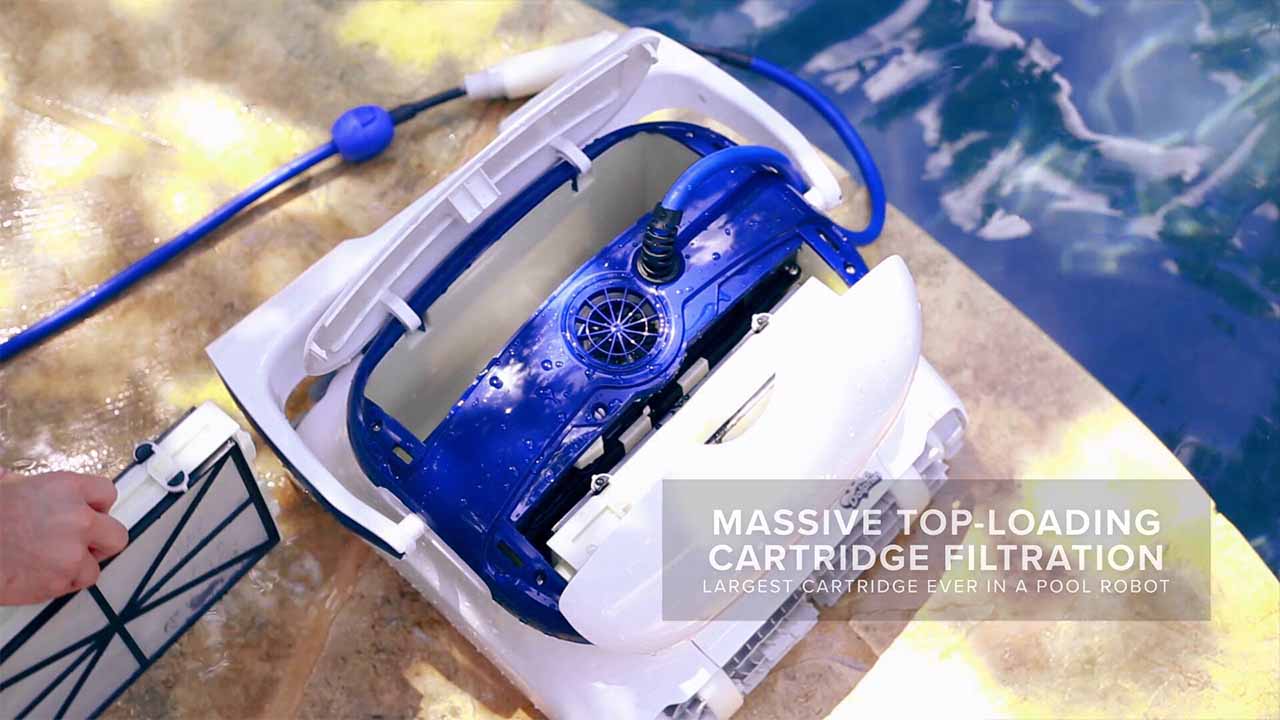
| Filtration | NanoFilters and standard filter cartridges | XXL MaxBin basket with standard and NanoFilter panels | Multi-Media: NanoFilters, oversized leaf bag and standard fine filters | MaxBin basket with fine panels; NanoFilter panels optional |
| Brushes | Quad scrubbing brushes | Dual HyperBrush | Dual scrubbing brushes | HyperBrush |
| Navigation | SmartNav 3.0 with gyroscope | SmartNav 2.0 | SmartNav 2.0 | SmartNav 2.0 |
| Cable | 55 ft with 360° anti-tangle swivel | 55 ft with anti-tangle swivel | 55 ft with 360° anti-tangle swivel | 50 ft |
| Warranty | 3 years | 2 years | 3 years | 2 years |
On smooth vinyl or fiberglass with balanced water, the difference between brush designs shrinks, and the choice falls back to pool size, coverage and price. Three jobs do separate a scrubbing robot from a vacuum on tracks:
Fast brushes and extra brushes both add scrubbing, but they add it differently. A HyperBrush makes more wipes per foot from a single roller, which keeps the robot light and simple: the Quantum weighs 18.3 lb and the Cayman 14.6 lb. Extra brushes add contact area and redundancy. With four on the Sigma, a strip that one brush skims over a seam or a pebble ridge is met by the next. The cost is weight, 24.6 lb, and price.
Count suits a textured pool that is used hard. Speed suits shelves, stairs and a tighter budget.
An active brush is a maintenance tool. Calcium scale, metal stains and black algae with roots in the plaster are bonded or embedded, and no robot brush is stiff enough to cut them. Those call for water chemistry, a stain treatment or a hand brush suited to the finish. A live bloom is the same story: treat the water and brush by hand first. Reach is the other limit. Top steps and shallow ledges are missed by most robots; of the four here, the Quantum alone publishes shelves, ledges and stairs.
Owners ask
It is a brush driven faster than the robot travels, so the bristles slide across the surface and scrub instead of rolling over it. Dolphin's HyperBrush is the clearest example, spinning at twice the speed of standard brushes. A robotic pool cleaner with active brushes loosens film that suction alone leaves behind.
The principle is the same: both spin at twice the speed of standard brushes. The Quantum has two of them and takes them to the waterline, shelves, ledges and stairs. The Cayman has one and covers floor and walls only.
A faster brush makes more contacts per cycle, so some extra wear is the price of extra scrubbing. In practice surface roughness and run frequency matter more than brush type. Every brush on these robots is a replaceable part. Look for a glazed or flattened surface and change the brush when you see it.
Not exactly, and we keep the terms apart. Active describes a brush geared to outrun the robot, such as the HyperBrush. Scrubbing brushes is how the Sigma's four and the Premier's two are described, with no speed claim attached. Both are built to scrub; one gets there by count, the other by speed.
Yes. The Escape carries one HyperBrush spinning at twice the speed of standard Dolphin brushes, and it is the lowest-priced Dolphin of the five compared here. It cleans floor and walls in a 1.5-hour cycle on pools up to 33 ft. The Cayman made this shortlist ahead of it for a longer 50 ft cable.
The verdict
Buy the Sigma when the pool is large, textured and expected to look perfect: four brushes and three motors are the most scrubbing on offer here. Buy the Quantum when you want the literal active brush, two of them, with shelf and stair coverage at a lower price. The Premier suits owners who prefer long cycles and simple controls. The Cayman is the answer for pools up to 33 ft. If a smooth pool only ever collects dust, brush design is not your deciding factor. Filtration is.
Keep reading