Dolphin Sigma
$2999 $2349 SALE Save $650
Temporarily out of stock


By debris and dirt problem
Top pick: Dolphin Sigma
$2349 today · Free shipping
Play sand and desert sand go straight through a standard panel. The right robot is the one with ultra-fine media in the box, used with the pump off.
The short answer
For fine sand, buy on filter media. The Dolphin Sigma is our top pick: NanoFilters are included, three motors supply 4,500 gallons per hour to pull water through them, and gyroscope navigation keeps its passes ordered. The Dolphin Premier is the alternative if you want the same NanoFilters with top-load swaps and no app. The Dolphin Quantum includes NanoFilter panels at a lower price.
You run the robot, and a pale plume rises from the top of it. That is fine sand going in through the intake and out through the filter. Play sand, wind-blown desert sand and the media from a pool sand filter are all small enough to pass a standard panel, so the best robotic pool cleaner for fine sand is first a question of filter media and only then of motors and brushes.
Three of the four picks include ultra-fine media as standard: NanoFilters on the Sigma and Premier, NanoFilter panels on the Quantum. The Dolphin Cayman qualifies only with its optional NanoFilter panels fitted. Technique matters as much as hardware. Fine sand has to be on the floor, not in suspension, before any robot can collect it, and the filter needs a thorough rinse between cycles.
The ranking
$2999 $2349 SALE Save $650
Temporarily out of stock
Top pick: NanoFilters, three motors, gyroscope
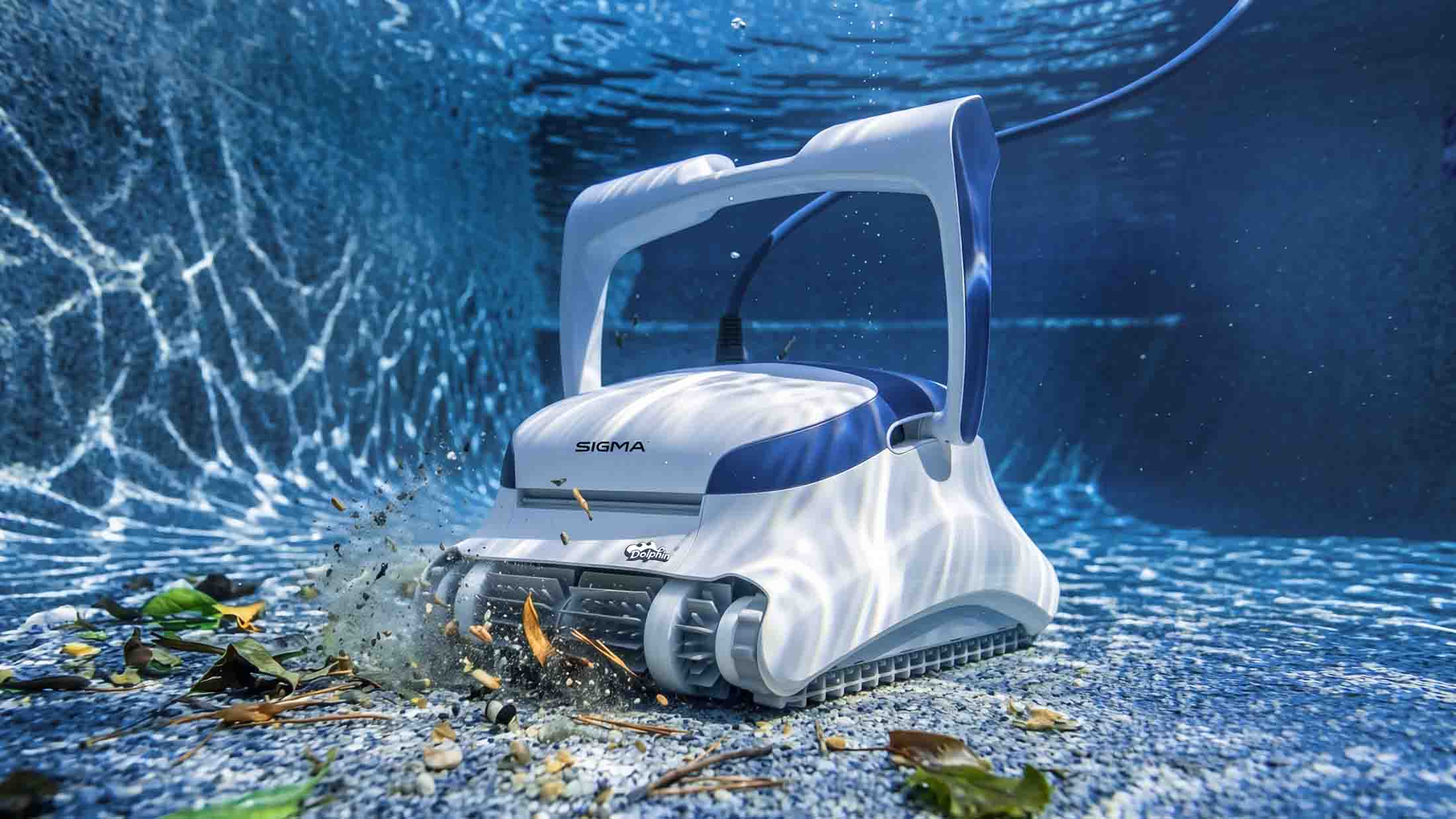
The Sigma ships with NanoFilters alongside its standard cartridges, so the media that holds fine sand is in the box. Three commercial-grade ProLine motors move 4,500 gallons per hour, the highest rating in this guide and one it shares with the Premier, which gives ultra-fine media the flow it needs. Four scrubbing brushes lift grains off the floor and walls.
SmartNav 3.0 and its onboard gyroscope hold the 2.5-hour cycle to an ordered pattern, the difference between an even floor and a striped one. The myDolphin Plus app adds a filter alert, useful when sand packs a filter sooner than you expect.

$2499 $1949 SALE Save $550
Temporarily out of stock
Same NanoFilters, tool-free swaps in seconds
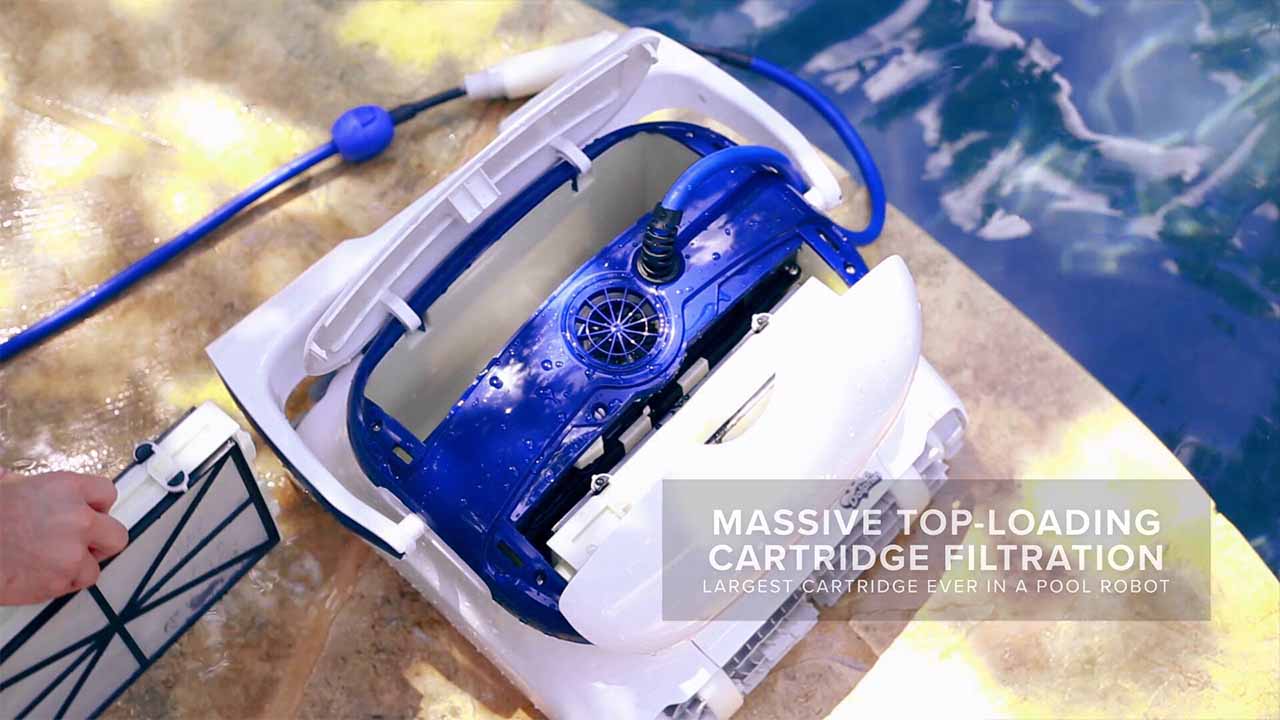
The Premier includes NanoFilters too, and its Multi-Media design makes the settle, run, rinse loop easy to live with. The filter loads from the top and changes in seconds with no tools, so a packed set comes out, gets hosed and goes back in with little fuss.
Flow matches the Sigma at 4,500 gallons per hour from dual ProLine motors, and the 3-hour cycle is the longest here. A full-filter indicator on the power supply tells you when sand has loaded the media.

$1799 $1599 SALE Save $200
Temporarily out of stock
Most filter area, lowest-priced 50 ft pick
The Quantum comes with a full set of NanoFilter panels as well as standard panels, mounted in an XXL MaxBin basket with over 400 sq in of filter area. Area matters with fine sand: the load spreads across more surface before flow falls away. The basket opens from the top with one click and rinses in the open, so packed sand is easy to see and hose out.
Dual HyperBrushes spin at twice the speed of standard brushes, the cycle is 2 hours, and it schedules from a weekly timer or the app. Among the 50 ft robots in this guide it carries the lowest price.

$1299 $1049 SALE Save $250
Temporarily out of stock
Budget route, with the optional panels
Be clear about the condition. As supplied, with its fine panels, the Cayman will pass much of a fine sand load back into the water. Fitted with the optional NanoFilter panels it becomes a workable choice for pools of 33 ft and under.
You then get a MaxBin basket 50% larger than standard Dolphin filters, a top hatch with one-tab emptying, a HyperBrush at twice the speed of standard Dolphin brushes and over 4,000 gallons per hour from dual 24-volt DC motors. Its timer runs every day, which helps where wind delivers a little sand daily.
The criteria
This is the pass or fail test. A standard filter holds leaves, grit and coarse sand. Fine sand goes through it and returns to the pool as a cloud. Check whether ultra-fine media is included or an extra purchase before comparing anything else.
Fine media resists water more than coarse media, and resists more as it loads. A robot needs flow in reserve. The Sigma and Premier are rated at 4,500 gallons per hour, the Quantum at 4,000, the Cayman at over 4,000.
A thin layer of fine sand shows every missed strip as a pale stripe. Navigation that works the floor in a pattern, and brushes that lift grains from the surface into the flow, decide how the pool looks after one cycle.
Clearing fine sand is a loop: settle, run, rinse, repeat. You will handle the filter several times in a weekend. How it opens, and how you know it is full, matter more here than on almost any other job.
On paper
| Specification | Dolphin Sigma | Dolphin Premier | Dolphin Quantum | Dolphin Cayman |
|---|---|---|---|---|
| Price today | $2349 | $1949 | $1599 | $1049 |
| Filtration | NanoFilters and standard filter cartridges | Multi-Media: NanoFilters, oversized leaf bag and standard fine filters | XXL MaxBin basket with standard and NanoFilter panels | MaxBin basket with fine panels; NanoFilter panels optional |
| Filter access | Cartridges | Top-load, no tools | Top-load, one-click open | Top hatch, one-tab emptying |
| Brushes | Quad scrubbing brushes | Dual scrubbing brushes | Dual HyperBrush | HyperBrush |
| Flow rate | 4,500 GPH | 4,500 GPH | 4,000 GPH | Over 4,000 GPH |
| Cycle time | 2.5 hours | 3 hours | 2 hours | 2 hours |
| Cleans | Floor, walls and waterline | Floor, walls and waterline | Floor, walls, waterline, sun shelves and stairs | Floor and walls |
| Scheduling | Weekly scheduler by day and time | Weekly timer: every day, every 2 days or every 3 days | Weekly timer: every day, every 2 days or every 3 days | Timer: every day |
| Warranty | 3 years | 3 years | 2 years | 2 years |
Fine sand in suspension cannot be vacuumed off the floor, because it is not on the floor yet. Turn the pool pump off and give the sand time to settle: a few hours at least, overnight after a storm. Keep swimmers out. Then run the robot with ultra-fine media fitted.
When the cycle ends, rinse the filter thoroughly. Fine sand packs into the pleats and corners of ultra-fine media, and a quick splash leaves most of it there. Hose from several angles until the water runs clear. Then repeat. After a desert dust storm, two or three cycles is a normal count, not a sign of a weak robot. Turn the pump back on between sessions so the pool's own filter takes what stayed suspended.
If fine sand collects beneath the return jets and comes back after every pump run, the robot is not the fix. That pattern means the pool's sand filter is leaking its own media into the return line, usually through a damaged lateral or standpipe. A robot with NanoFilters will collect each deposit. The filter will lay down another.
Compare a pinch from the pool floor with the sand in the filter tank if you can. Same color and grain means the source is on the equipment pad. Repair it first, then let the robot remove what is left in the pool.
A robot handles only what is already in the water. In sandy, windy areas a cover on windy days cuts the load most. Planting or a solid fence on the windward side helps. Keep play sand in a lidded sandbox set back from the deck, with a rinse station between it and the pool. Sweep or blow the deck away from the water, not toward it.
None of this replaces the skimmer, the pool filter or sanitizer. The robot's part is the floor and the walls.
Owners ask
The filter media is too coarse for the grain. Water carries the sand in, the panel does not hold it, and it leaves with the outflow as a pale cloud. Fit NanoFilters on the Sigma or Premier, or NanoFilter panels on the Quantum. The Cayman and Escape need the optional NanoFilter panels. Also confirm the filter is seated and undamaged.
Off, for this job. Circulation keeps fine sand moving and lifts it back off the floor near the returns. With the pump off, the sand stays settled where the robot can reach it. Run the pump between robot cycles so the pool filter can take what is still suspended, then switch it off and let the water go still before the next run.
Plan on two or three, with a filter rinse between each. The first cycle removes most of the settled sand, and more settles out of the water afterward. That count assumes ultra-fine media and a pump that was off during settling. If the floor looks no better after three cycles, check the filter for damage and look for a continuing source.
The robot can be the same; the filter is not. Regular beach sand is held by standard filters. Fine sand needs ultra-fine media, which is included with the Sigma, Premier and Quantum and optional on the Cayman. Flow matters more too, because ultra-fine media is harder to pull water through, especially once it starts to load.
The verdict
Fine sand is a media problem with a method attached. Any pick with ultra-fine filters, used on settled sand with the pump off and rinsed every cycle, will clear it. Choose the Sigma if fine sand is frequent and the pool is large, the Premier for the simplest swaps, the Quantum for the lowest price with panels included, and the Cayman only with its add-on panels. Unsure which case is yours? Ask a Dolphin expert.
Keep reading