Dolphin Premier
$2499 $1949 SALE Save $550
Temporarily out of stock


By debris and dirt problem
Top pick: Dolphin Premier
$1949 today · Free shipping
Seed pods, blossoms, small sticks and mulch need room, not finer filtration. Here is which robot swallows the most, and what still has to come out by hand.
The short answer
For large debris we rank the Premier first: its oversized leaf bag gives bulky pieces an open place to go. The Quantum is a close second with the XXL MaxBin, the largest basket on this page, and suits owners who prefer a rigid, one-click basket. Anything larger than the robot's intake still has to be removed by hand.
What marks out the best robotic pool cleaner for large debris is that it gets in its own way the least. Large debris means what a pool collects from a yard: whole leaves, seed pods, spent flowers, small sticks, and bark mulch washed in by rain. None of it is hard to lift. All of it is awkward to store.
Two parts of a robot decide whether a seed pod ends up in the collector or stuck in the way: the intake path from the underside to the filter, and the filter itself. A wide path into an open bag or large basket works; a fine filter blankets over and stops the flow. And there is a hard upper limit no robot escapes: a piece larger than the intake stays in the pool.
The ranking
$2499 $1949 SALE Save $550
Temporarily out of stock
An open leaf bag for bulky pieces
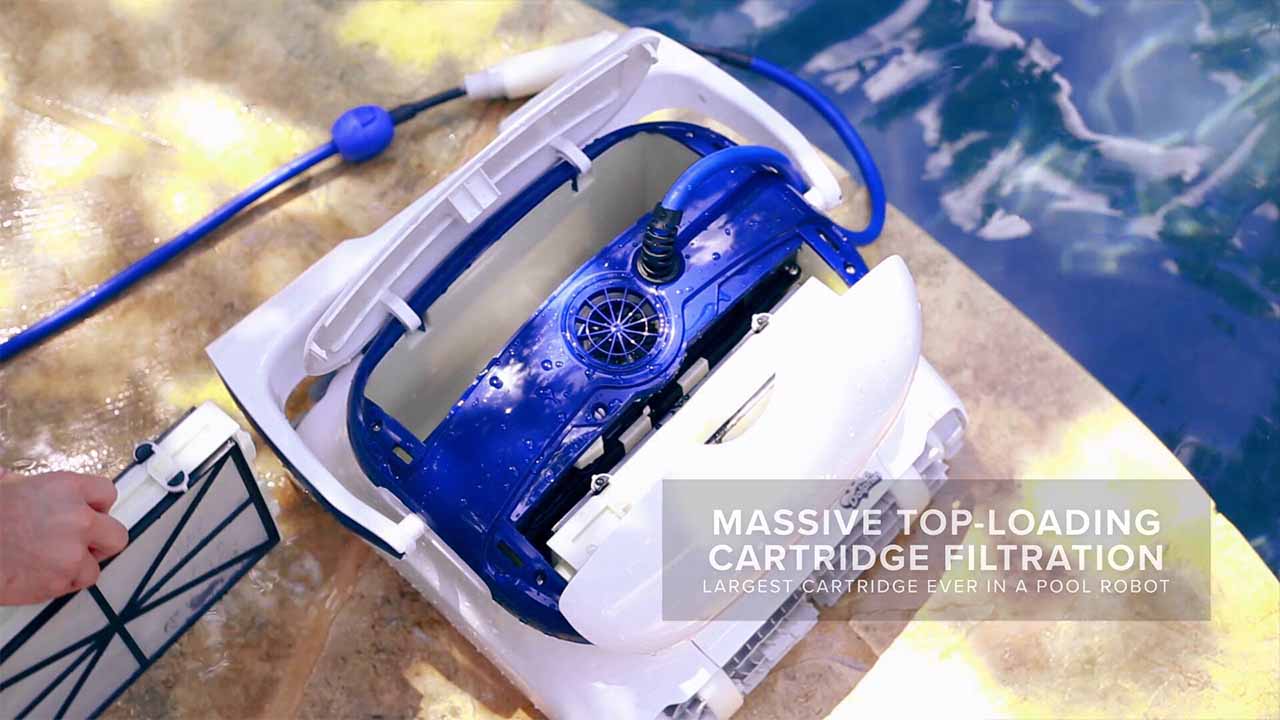
Large, irregular debris wants a soft, open collector, and the Premier includes one: the oversized leaf bag in its Multi-Media set. Pods, blossoms and mulch drop into it without lying flat across a filter face, so water keeps moving while the bag fills. Its dual commercial-grade ProLine motors deliver 4,500 gallons per hour, which helps carry awkward pieces up from the floor. For loads too messy to rinse, disposable debris bags are an optional fourth media choice. NanoFilters and standard fine filters are in the box for the cleanup after.

$1799 $1599 SALE Save $200
Temporarily out of stock
Largest rigid basket, one-click access
If you would sooner tip out a basket than handle a bag, the Quantum is the equal choice. The XXL MaxBin has more than 400 square inches of filter area to work with, more basket than any other robot in this guide. One click opens it from the top, and a rigid basket is easy to pick a wedged stick out of. The dual HyperBrush, at twice the speed of standard brushes, sweeps debris toward the intake, and coverage extends to sun shelves, Baja ledges and stairs, where pods and petals collect in shallow water.

$2999 $2349 SALE Save $650
Temporarily out of stock
Mixed debris with a fine finish
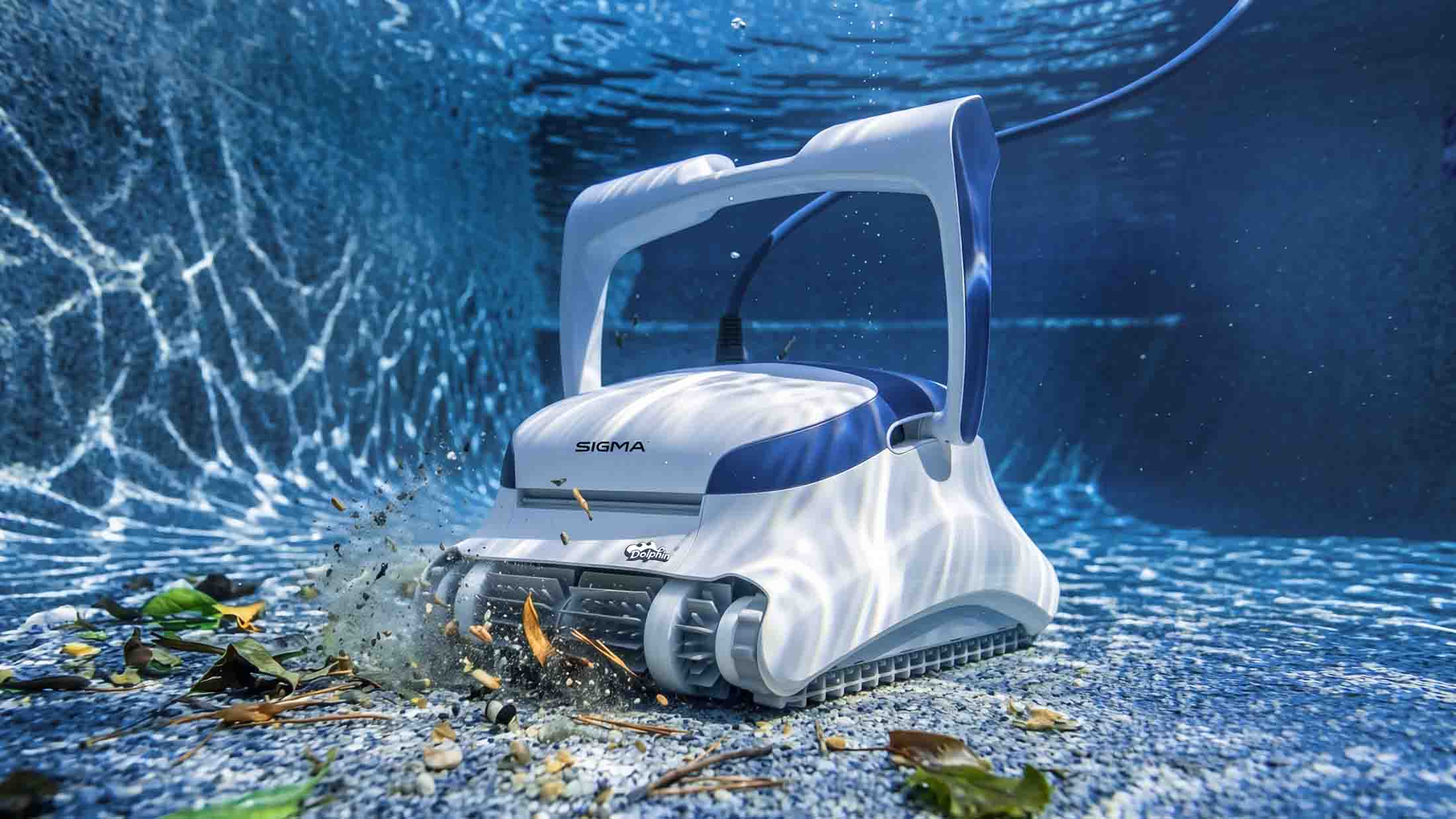
The Sigma is the power pick, not the capacity pick. Its three commercial-grade ProLine motors and four scrubbing brushes have no trouble lifting large pieces: 4,500 gallons per hour is the highest flow on this page, matched by the Premier alone. Storing them is the limit. Its filters are cartridges, designed around finer material, and bulky pieces use up their space quickly. It ranks third because many pools see large debris only now and then, and for that mix the Sigma's NanoFilters and in-app filter alert are the better everyday tools.

$1299 $1049 SALE Save $250
Temporarily out of stock
Everyday yard debris, pools to 33 ft
For a pool of 33 ft or less, the Cayman's MaxBin handles ordinary large debris without fuss. The basket is 50% larger than standard Dolphin filters, its fine panels pass water around leaves and pods, and one tab on the top hatch releases it for emptying. Two 24-volt DC motors give a flow of over 4,000 gallons per hour, and one HyperBrush at twice the speed of standard Dolphin brushes covers floor and walls in a 2-hour cycle. The timer runs every day, so debris is collected before it breaks down into smaller, harder-to-catch pieces.
The criteria
Bulky debris needs volume and free-flowing media. Two collectors on this page are built for it: the oversized leaf bag in the Premier's media set and the Quantum's XXL MaxBin, a basket with more than 400 square inches of filter area. The MaxBin on the Cayman is 50% larger than standard Dolphin filters. Cartridges, as on the Sigma, are designed for finer material.
Ultra-fine filters are the wrong fit for this job. A handful of petals or pods spreads across fine media like a lid, and the flow stops. Use the leaf bag or standard panels for big debris, and keep NanoFilters for the cleanup pass afterward.
Large debris means frequent emptying, and sometimes fishing out one stick that has wedged across the basket. A collector that lifts out of the top without tools makes both quick. The Premier, Quantum and Cayman all open from above.
Every robot has intake openings on its underside, and those openings are the size limit. Dolphin does not publish a maximum debris size, so use the opening as the gauge: if a piece is longer or wider than it, pick the piece up by hand before the cycle.
On paper
| Specification | Dolphin Premier | Dolphin Quantum | Dolphin Sigma | Dolphin Cayman |
|---|---|---|---|---|
| Price today | $1949 | $1599 | $2349 | $1049 |
| Filtration | Multi-Media: NanoFilters, oversized leaf bag and standard fine filters | XXL MaxBin basket with standard and NanoFilter panels | NanoFilters and standard filter cartridges | MaxBin basket with fine panels; NanoFilter panels optional |
| Filter access | Top-load, no tools | Top-load, one-click open | Cartridges | Top hatch, one-tab emptying |
| Brushes | Dual scrubbing brushes | Dual HyperBrush | Quad scrubbing brushes | HyperBrush |
| Flow rate | 4,500 GPH | 4,000 GPH | 4,500 GPH | Over 4,000 GPH |
| Cycle time | 3 hours | 2 hours | 2.5 hours | 2 hours |
| Cleans | Floor, walls and waterline | Floor, walls, waterline, sun shelves and stairs | Floor, walls and waterline | Floor and walls |
| Scheduling | Weekly timer: every day, every 2 days or every 3 days | Weekly timer: every day, every 2 days or every 3 days | Weekly scheduler by day and time | Timer: every day |
| Warranty | 3 years | 2 years | 3 years | 2 years |
Sort yard debris into three groups before a cycle, because a robot treats each one differently. Soft bulk, such as leaves, petals, pods and mulch, is what bags and baskets are for. Long or rigid pieces, such as sticks, are a matter of size: short ones pass, long ones lodge across the opening and stop everything behind them. Hard, dense objects, such as stones, are the ones to keep out altogether, because they can jam an impeller. The table gives the practical call for each.
| Debris | Robot handles it? | What to do |
|---|---|---|
| Whole leaves, petals, seed pods, mulch | Yes, with a bag or basket and coarse media | Empty often; follow with fine filters |
| Small sticks and twigs | Short ones; long ones bridge the intake | Pick out anything longer than the intake opening |
| Acorns, nuts, small cones | Often, but hard pieces can lodge | Check the intake if collection stops |
| Stones, gravel, coins, screws | Not reliably; can jam an impeller | Remove by hand before the cycle |
| Branches, palm fronds, large toys | No | Remove by hand |
A jam usually announces itself: the robot keeps moving but leaves debris behind, stops climbing, or stops altogether. Unplug the power supply before you touch the robot. Lift it out, open the top and empty the collector, then look at the intake openings underneath for a stick or pod lodged across them.
If the impeller itself is blocked, by a stone or a hard seed, follow the manual's steps for reaching it. Do not run the robot again until the obstruction is out. If you are unsure what you are looking at, ask a Dolphin expert before taking anything apart.
Fitting the finest media and leaving it there backfires with large debris. Fine media depends on a large clean area to pass water. One layer of petals or wet leaves covers that area, the flow drops, and the robot loses both its pickup and its grip on the walls. Coarse media and open bags tolerate a covering of big pieces because water finds a way around them. So work in two stages: coarse for the bulk, then a cycle on NanoFilters or NanoFilter panels for what the first stage left.
Owners ask
Up to the size of its intake openings, and no larger. Dolphin does not publish a maximum debris size, so the opening on the underside of the robot is your gauge. Leaves, pods and short twigs pass. Anything longer or wider than the opening either stays on the floor or lodges across it.
Small gravel may pass into the collector. A larger stone can lodge in the intake or reach the impeller and jam it. If the robot stops collecting or stops moving, unplug it, empty it and check the intake before running it again. Removing stones by hand before a cycle is the cheaper option.
Yes. Dive rings, small toys, goggle straps and hair ties are the right size to block an intake or wrap around a brush. A quick look across the floor before the scheduled cycle saves a stalled robot.
Only if it can change media. Large debris wants an open bag or coarse panels; fine dust wants ultra-fine filters. The Premier and Quantum include both, which is why they lead this page. The Sigma is the stronger choice when fine dust is the main load and large debris is the exception.
The verdict
Rank robots for large debris by their collectors. Bag or basket is a matter of preference: the Premier for the open leaf bag and the widest choice of media, the Quantum for the largest rigid basket and one-click access. The Cayman does the same job in pools of 33 ft or less. The Sigma belongs in pools where bulk is rare. Whatever you choose, the intake sets the limit, so what will not fit comes out by hand first.
Keep reading