Dolphin Sigma
$2999 $2349 SALE Save $650
Temporarily out of stock


By steps, ledges and tricky features
Top pick: Dolphin Sigma
$2349 today · Free shipping
Leaves, acorns and silt all slide to the lowest point of the pool. The right robot has the capacity, the time and the cable slack to deal with them there.
The short answer
The Dolphin Sigma is our first pick for deep ends: three motors and 4,500 GPH lift what packs around the main drain, NanoFilters hold the silt, and the app warns you when the filter is full. Choose the Dolphin Premier instead if your deep end fills with whole leaves, since its oversized leaf bag and 3-hour cycle are built for volume. The Dolphin Quantum and Dolphin Cayman follow.
The deep end is the pool's dustpan. The floor slopes toward it, the main drain pulls toward it, and anything heavier than water finishes its journey there: leaves, acorns, seed pods, and the fine silt that drifts down last and settles around the drain cover. A pool can look clean from the shallow end and still have a week of debris sitting under 8 ft of water.
That changes what you ask of a robot. The best robotic pool cleaner for deep ends is not simply the one that can get there. All four picks can. It is the one with the capacity to hold what it finds, the cycle time to keep coming back, and enough slack in the cable to work the bottom without being held short. This page is about debris and reach, not depth itself.
The ranking
$2999 $2349 SALE Save $650
Temporarily out of stock
Silt, suction and a full-filter alert
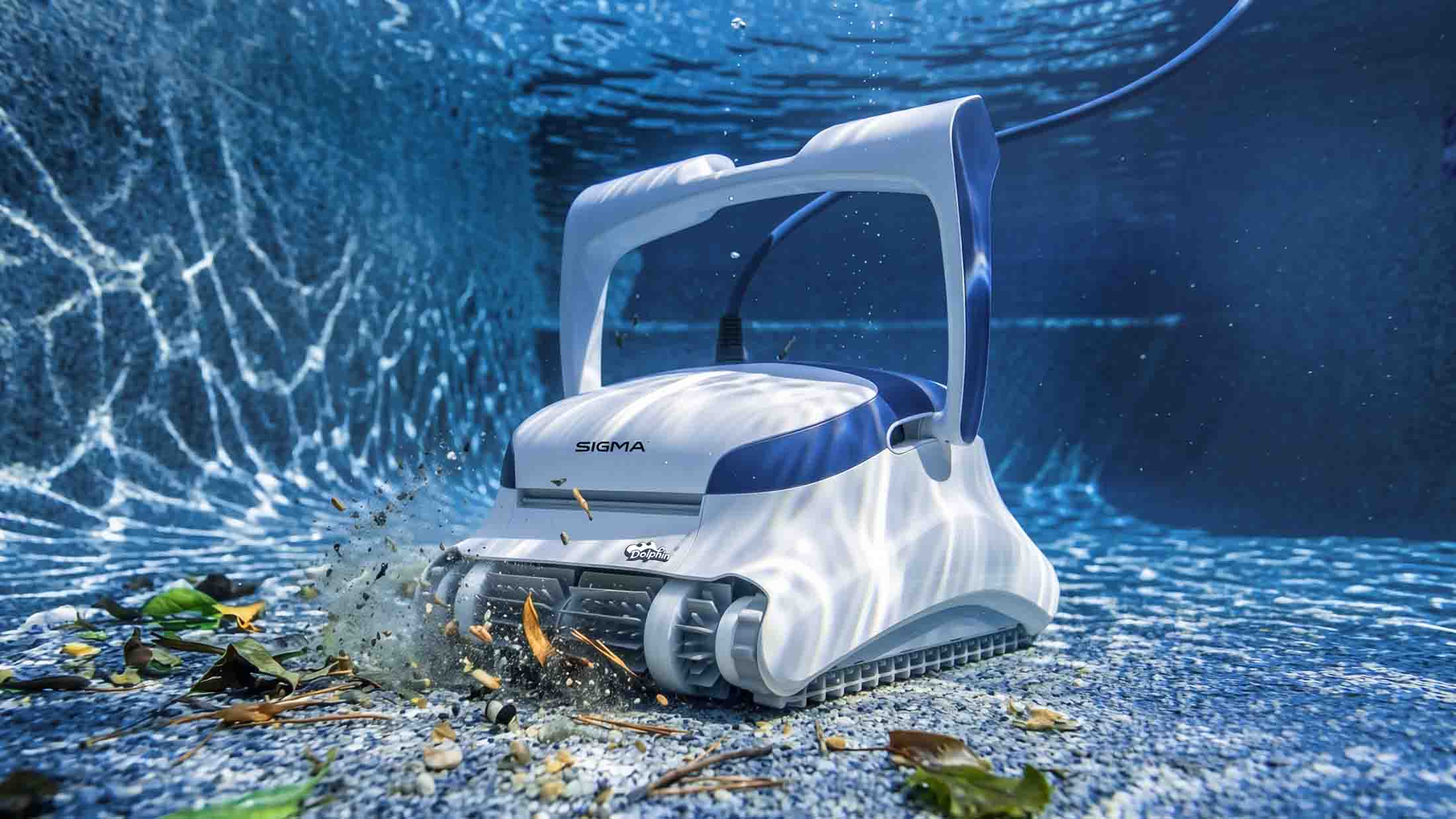
The deep end's hardest debris is the fine layer packed around the drain, and that is where the Sigma is strongest. Its three commercial-grade ProLine motors pull 4,500 GPH through the filter, quad scrubbing brushes loosen what has settled, and NanoFilters come in the box alongside standard cartridges for mixed loads. Its gyroscope holds a heading on the slope, so it climbs out and returns to the drain instead of circling. When the cartridges are full, the app tells you, which removes the usual cause of a robot stalled at the bottom. A 360-degree swivel on the 55 ft cable is the cure for the other cause.

$2499 $1949 SALE Save $550
Temporarily out of stock
The leaf bag for a deep end full of leaves
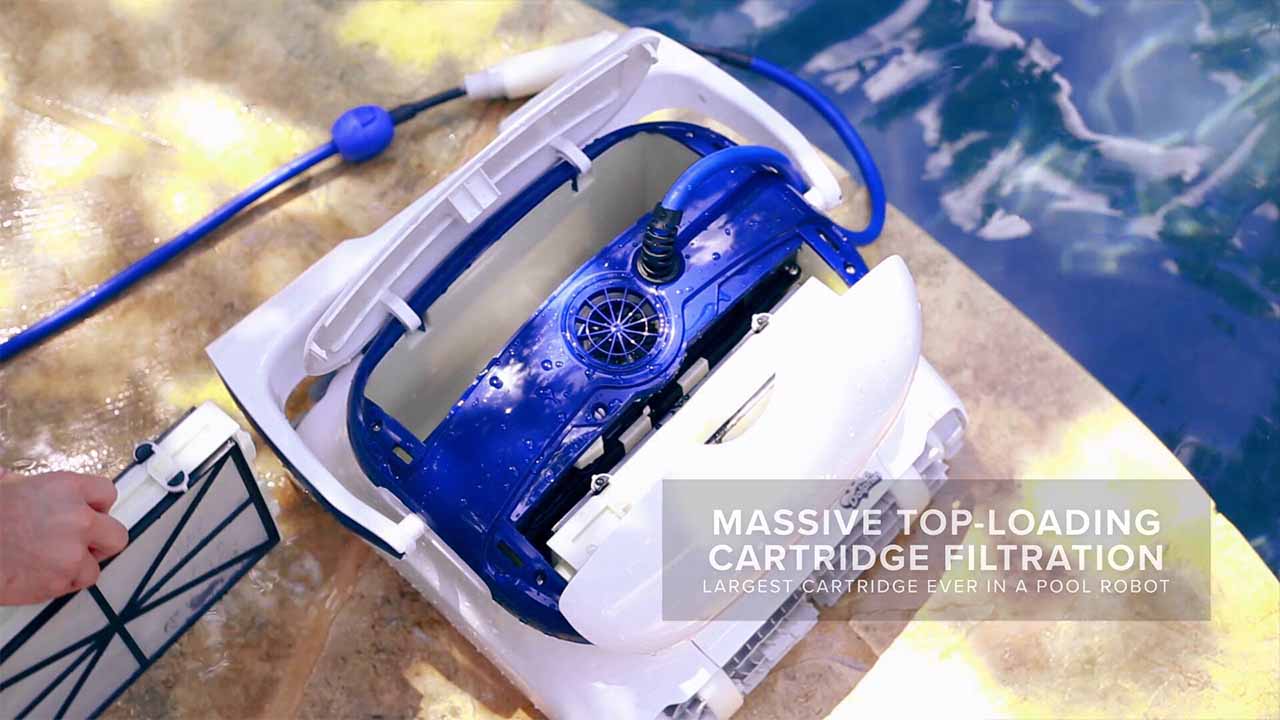
When the debris is bulk, capacity decides, and the Premier's Multi-Media system has the answer in the box: an oversized leaf bag for leaves, acorns and pods, NanoFilters for silt, and standard fine filters for ordinary weeks, each swapped in seconds through the top without tools. It runs for 3 hours, longer than any other pick, which is more trips down to the drain and back before it stops. Two commercial-grade ProLine motors give it 4,500 GPH of flow, and the 55 ft swivel cable matches the Sigma's reach. A full-filter indicator on the power supply shows when the bag needs emptying.

$1799 $1599 SALE Save $200
Temporarily out of stock
An XXL basket, emptied in one click
The Quantum's XXL MaxBin basket, at over 400 sq in, opens from the top with one click, so emptying a deep-end load takes moments. Standard panels and a full set of NanoFilter panels are both included, which covers leaves one week and silt the next. Dual HyperBrushes, twice as fast as standard brushes, break up what has settled, and the 55 ft cable has an anti-tangle swivel. Its cycle is 2 hours. For a deep end that refills quickly, set the weekly timer to every day so the pile never has time to build.

$1299 $1049 SALE Save $250
Temporarily out of stock
Daily cycles for deep ends in shorter pools
In a pool of 33 ft or less, the Cayman's answer to the deep end is routine. Its timer runs a 2-hour cycle every day, so the robot meets one day of debris at the drain, not seven. The MaxBin basket is 50 percent larger than standard Dolphin filters and empties through a top hatch with one tab; NanoFilter panels are an optional add-on if silt is the issue. Watch the cable: 50 ft with no swivel, so keep the power supply on the deep-end side and straighten the cable when you empty the basket.
The criteria
A robot fills up where the debris is. If the filter is full early in the cycle, the remaining time is wasted. Look at how much the robot holds and how it is emptied: cartridges, a basket and a leaf bag each suit a different load.
Bulk debris and fine debris want opposite filters. Leaves and acorns need volume and an open weave. Silt needs fine media, and fine media clogs fast when leaves are mixed in. Know which one your deep end collects before you choose.
The deep-end floor is the farthest point from the power supply in every direction that counts: across, along and down. If the cable is taut there, the robot cleans a tethered arc and leaves the rest.
A loaded filter is the usual reason a robot gives up at the bottom. A robot that tells you so saves a wasted cycle. The Sigma sends a filter alert to your phone, and the Premier shows a full-filter indicator on its power supply.
On paper
| Specification | Dolphin Sigma | Dolphin Premier | Dolphin Quantum | Dolphin Cayman |
|---|---|---|---|---|
| Price today | $2349 | $1949 | $1599 | $1049 |
| Cleans | Floor, walls and waterline | Floor, walls and waterline | Floor, walls, waterline, sun shelves and stairs | Floor and walls |
| Traction | HyperGrip tracks | HyperGrip tracks | HyperGrip tracks | HyperGrip tracks |
| Navigation | SmartNav 3.0 with gyroscope | SmartNav 2.0 | SmartNav 2.0 | SmartNav 2.0 |
| Cable | 55 ft with 360° anti-tangle swivel | 55 ft with 360° anti-tangle swivel | 55 ft with anti-tangle swivel | 50 ft |
| Robot weight | 24.6 lb | 20.3 lb | 18.3 lb | 14.6 lb |
| Warranty | 3 years | 3 years | 2 years | 2 years |
Three things move debris to the deep end. The floor slopes that way, so anything that sinks keeps rolling until it runs out of slope. The main drain draws water toward the lowest point whenever the pump is on. And deep water is the stillest in the pool, so the finest material, the silt that stays suspended for hours, finally settles there.
The result is a pile with layers: leaves and acorns underneath, silt on top and around the edges. A robot with a fine filter fitted will clog on the leaves before it reaches the silt. If your deep end holds both, clear the bulk first with the coarser media or a leaf net, then run a cycle with fine filters for what is left.
Cable is measured to the farthest, lowest point the robot must reach, and that is the deep-end floor. Put the power supply closer to the deep end than the shallow end, at the setback your manual requires, so the cable has slack to reach the bottom. The shallow end needs less cable because it needs no depth.
Feed in enough cable for the robot to reach every corner of the deep-end floor, and no more. Too little and the robot is held on a leash. Too much and the spare loops drift into its path. On the Sigma, Premier and Quantum a swivel takes out the twist as the robot turns. The Cayman has none, so lay its cable out straight on the deck each time you empty the basket.
Owners ask
Often for no bad reason: the cycle ended while it was there, and the floor slopes that way. It matters only if the robot stops there early or the shallow end is being missed. Then look for a full filter, which cuts the suction it needs to climb out, or a twisted cable, which shortens itself and holds the robot short. Empty the filter, straighten the cable and watch one more cycle before calling it a fault.
Nearer the deep end. The cable has to reach the deep-end floor, which costs length for depth as well as distance, while the shallow end is an easy reach. Keep to the setback in your manual.
Yes, within its filter's capacity. Acorns and small twigs are the kind of debris these robots collect; what limits them is volume. The Premier's oversized leaf bag and the Quantum's XXL MaxBin basket hold the most. With the Sigma's cartridges or the Cayman's basket, empty more often in the fall, and net a heavy pile before the cycle.
Do it in two stages. Start with the coarser media, the Premier's leaf bag or the standard panels and cartridges on the others, to take out the bulk without clogging. Then switch to NanoFilters for the fine layer. The Sigma, Premier and Quantum include them; on the Cayman they are an optional add-on.
The verdict
Name the debris and the pick follows. Silt, dust and mixed fine material in a pool up to 50 ft: the Sigma. Whole leaves and acorns by the bucket: the Premier and its leaf bag. A bit of both on a tighter budget: the Quantum, on a daily timer. A pool of 33 ft or less: the Cayman, every day. With any of them, put the power supply toward the deep end and keep the filter empty. Every robot here comes with the full Maytronics warranty.
Keep reading