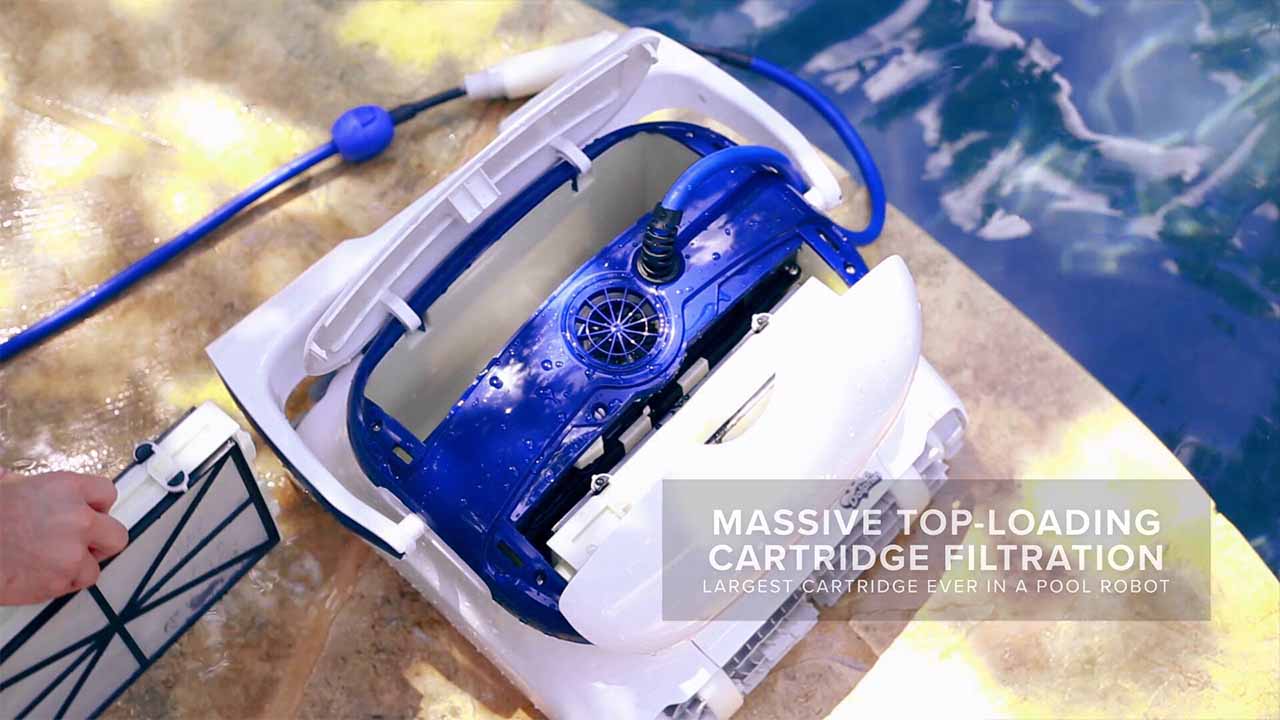
Dolphin Sigma
$2999 $2349 SALE Save $650
Temporarily out of stock


By steps, ledges and tricky features
Top pick: Dolphin Sigma
$2349 today · Free shipping
No robot levels a floor. The right one rides over dips, wrinkles and patches without stalling, and is light enough for the base beneath it.
The short answer
For an uneven in-ground floor, choose the Dolphin Sigma: it runs on HyperGrip tracks, and its gyroscope lets it re-orient after a dip or ridge tips it. The Dolphin Quantum comes second, lighter at 18.3 lb on continuous rubber tracks. On a soft above-ground base the pick is the Dolphin Cayman at 14.6 lb. The Dolphin Premier suits patched plaster, where its 3-hour cycle helps.
Pool floors are rarely as flat as the plans said. Vinyl bottoms settle or wash out and leave soft hollows. Above-ground pools on a sand base keep every footprint from the day they were filled. Liners wrinkle. Plaster heaves, cracks and gets patched, and old pools carry abandoned drains and fittings that stick up from the surface. All of it is survivable for a robot, but not equally for every robot.
Three properties decide how the best robotic pool cleaner for uneven floors behaves: what it drives on, how much it weighs and what it does after it has been tipped. Every Dolphin here drives on tracks, which ride over unevenness far better than wheels, so the first is settled. The ranking below turns on the other two, and on whether your pool is in the ground or above it.
The ranking
$2999 $2349 SALE Save $650
Temporarily out of stock
Recovers when the floor tips it
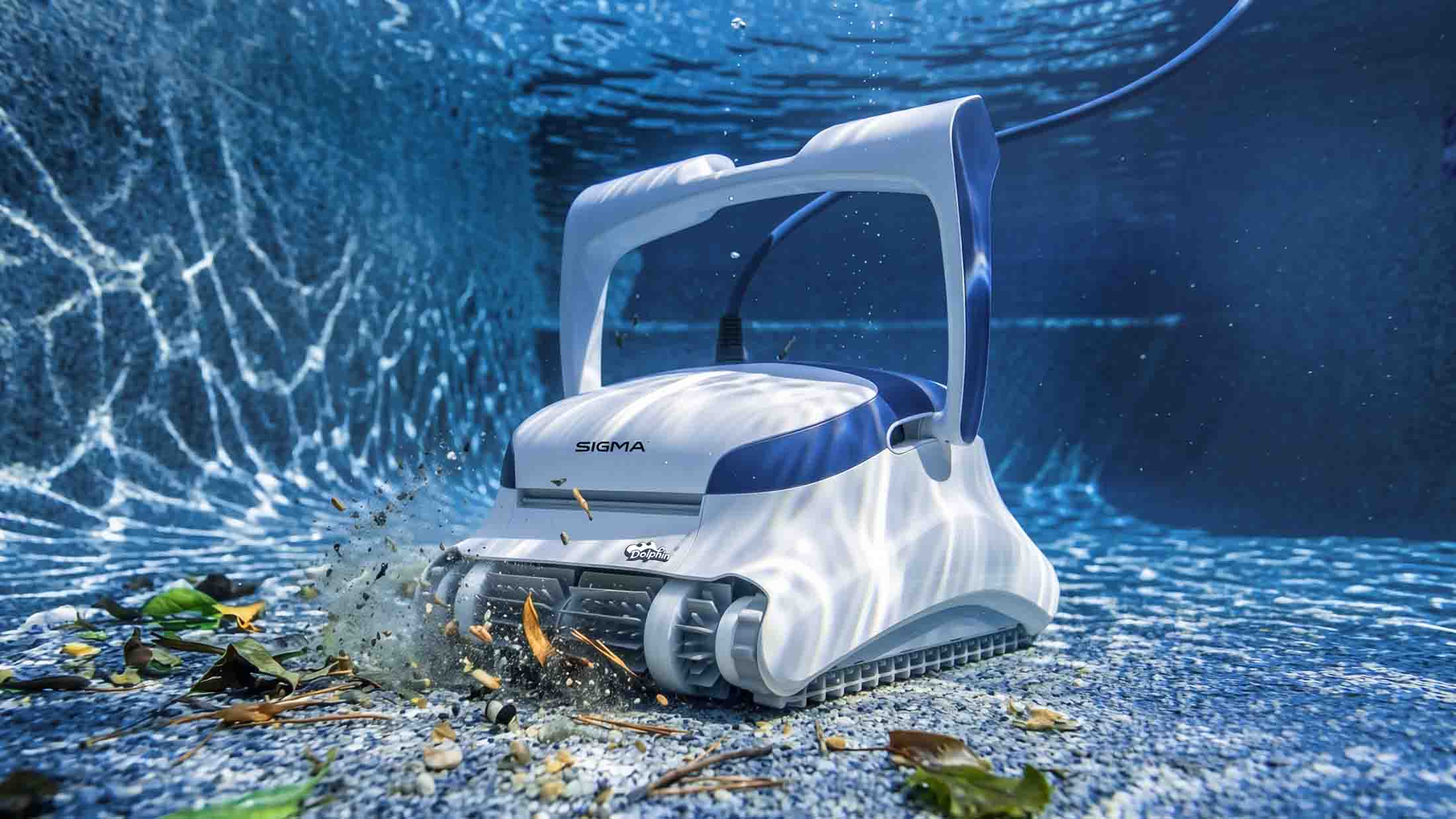
On an in-ground floor with heaves, patches or ridges, the Sigma has the one feature the others lack: an onboard gyroscope in its SmartNav 3.0 navigation. When a ridge lifts one track or a hollow pitches the robot forward, it senses the change and re-orients instead of pressing on blind. Four scrubbing brushes mean some brush stays in contact when the floor falls away under part of the robot, and three commercial-grade ProLine motors with 4,500 GPH pull fine debris out of low spots. Vinyl liner, plaster, gunite, pebble and tile are all published surfaces.

$1799 $1599 SALE Save $200
Temporarily out of stock
Continuous rubber tracks at 18.3 lb
The Quantum's drive is described as HyperGrip continuous rubber tracks, and continuity is the point on a broken surface: a full band of rubber stays in contact across an edge. At 18.3 lb it is the lightest of the 50 ft robots in this guide, over 6 lb under the Sigma, which is kinder to a vinyl floor over a soft base. SmartNav 2.0 scanning senses ladders and drains, useful around old fittings. It has no gyroscope, so recovery from a tip comes from scanning alone. An XXL MaxBin basket with NanoFilter panels included handles what the hollows hold.

$1299 $1049 SALE Save $250
Temporarily out of stock
Light enough for soft above-ground bases
Footprints and divots in a sand base are an above-ground problem, and the Cayman is the pick here that is published for above-ground pools. At 14.6 lb it puts the least load on a soft bottom of any robot in this ranking, and it still drives on HyperGrip tracks, so a dimpled liner is ridden over, not fallen into. Vinyl liner is on its published surface list. It works in-ground too, up to 33 ft, with one HyperBrush and a MaxBin basket. The Escape, lighter still at 14.2 lb, is also suitable above ground; what the Cayman adds is 10 ft of cable and daily scheduling.

$2499 $1949 SALE Save $550
Temporarily out of stock
A long cycle for patched plaster and old fittings
The Premier sits fourth because it is the second heaviest robot here at 20.3 lb and has no gyroscope, but on a hard uneven floor it has a real argument. Its obstacle list names drain covers and pop-up heads, the fittings that stick up from old plaster, and no pick runs longer than its 3 hours, so a floor that slows a robot down still gets covered. HyperGrip tracks and dual commercial-grade ProLine motors do the driving. If patches and rough plaster shed grit, the NanoFilters in the Multi-Media set catch it.
The criteria
A track spans a dip that a wheel drops into, and it keeps some grip on the far side while the near side is in the air. All of the robots in this guide run on HyperGrip tracks. On an uneven floor that is the minimum, not a bonus.
A soft base gives under load. The lighter the robot, the less it presses into a sand bottom and the easier it is to set down gently. Among the picks, the Cayman is lightest at 14.6 lb and the Sigma heaviest at 24.6 lb.
A ridge or the lip of a divot can tilt a robot onto one track. A robot that senses its own attitude knows it has been tipped and re-orients. One that does not carries on until its scanning pattern takes it elsewhere.
Brushes bridge a hollow; water flow does not. Debris collects in low spots because that is where water slows, so flow rate matters on a dimpled floor: 4,500 GPH on the Sigma and Premier, 4,000 on the Quantum, over 4,000 on the Cayman.
On paper
| Specification | Dolphin Sigma | Dolphin Quantum | Dolphin Cayman | Dolphin Premier |
|---|---|---|---|---|
| Price today | $2349 | $1599 | $1049 | $1949 |
| Cleans | Floor, walls and waterline | Floor, walls, waterline, sun shelves and stairs | Floor and walls | Floor, walls and waterline |
| Traction | HyperGrip tracks | HyperGrip tracks | HyperGrip tracks | HyperGrip tracks |
| Navigation | SmartNav 3.0 with gyroscope | SmartNav 2.0 | SmartNav 2.0 | SmartNav 2.0 |
| Cable | 55 ft with 360° anti-tangle swivel | 55 ft with anti-tangle swivel | 50 ft | 55 ft with 360° anti-tangle swivel |
| Robot weight | 24.6 lb | 18.3 lb | 14.6 lb | 20.3 lb |
| Warranty | 3 years | 2 years | 2 years | 3 years |
Walk the pool, or feel the floor with a brush from the deck, and work out which kind of unevenness you have. The cause decides both the robot and whether a repair should come first.
A robot cleans the floor you have. It will not level it, press out a wrinkle or fill a void, and running it more often does not change that. What it can do is stall. A divot deeper than the tracks can bridge, or a wrinkle tall enough to act as a curb, will hold a robot until the cycle ends, and it will hold it again tomorrow.
If the robot stops in the same place twice, treat that place as a repair, not a robot fault. Large liner wrinkles can often be reset by a liner installer, and a washed-out base can be rebuilt when the liner is next replaced. Until then, a quick brush of that one spot is the honest workaround.
On a sand base the robot's weight matters twice: once while it drives, and once when you put it in. A robot weighs less in water than on a scale, but a lighter machine still presses less into a soft bottom. Lower it in by hand and let it settle; never drop it. The Sigma, Quantum and Premier are in-ground robots and should not be used here. The Cayman is the pick, with the Escape as the lighter, lower-priced alternative outside this shortlist.
Owners ask
In a shallow one, no: tracks bridge it and the robot carries on. In a deep divot with steep sides it can stall, and so can any robot. The Sigma's gyroscope helps it re-orient after being tipped, which gets it out of more situations, but a hole that traps the robot every cycle needs repairing, not a different robot.
Small wrinkles, yes. Tracks ride over them, and vinyl liner is a published surface for every pick here. A big wrinkle is different: it acts like a curb, and the robot can stall behind it. Have large wrinkles reset, and brush along the small ones now and then, since they trap fine dirt.
Weight is one reason to avoid it, but not the main one. The three heavier robots here are in-ground robots and are not published for above-ground pools at all. For a sand base, stay with the Cayman at 14.6 lb or the Escape at 14.2 lb, and lower either one in gently so it does not dent the bottom on the way down.
Tracks. A track spreads the robot's weight over a long contact area and spans gaps that a wheel would drop into. All five Dolphins compared in these guides use HyperGrip tracks, so within this range the choice comes down to weight, navigation and pool type, not drive.
The verdict
That question comes first. In-ground with heaved or patched plaster or a hard, ridged floor: the Sigma, for the gyroscope that lets it recover. In-ground but soft underfoot: the Quantum, the lightest 50 ft robot here. Above-ground on sand: the Cayman, or the lighter Escape. Old hard plaster with raised fittings and no need for an app: the Premier. And if the robot stops in the same spot twice, fix the floor, not the robot.
Keep reading