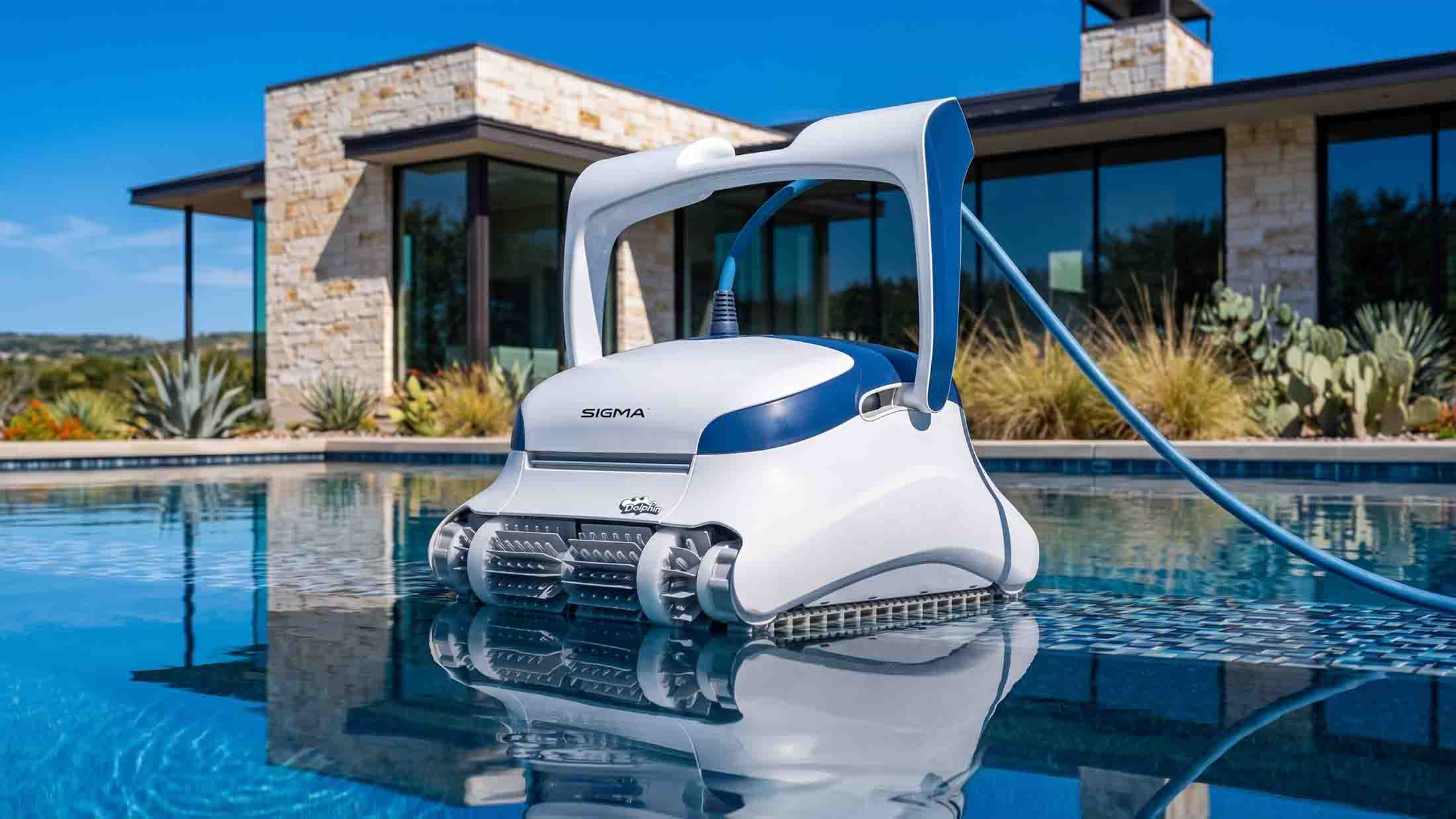
Dolphin Sigma
$2999 $2349 SALE Save $650
Temporarily out of stock


By pool type and installation
Top pick: Dolphin Sigma
$2349 today · Free shipping
No Dolphin here is published as approved for a natural swimming pool, but a robot can keep the lined swimming zone clear of sediment and biofilm if you set firm boundaries.
The short answer
With that limit stated, Dolphin Sigma is the robot we would put in a natural pool's swimming zone: NanoFilters described as filtering to 2 microns for sediment, quad scrubbing brushes for biofilm, and a scheduler for frequent runs. The Premier is the alternative when leaf litter from the planting is heavy, because an oversized leaf bag comes in its box.
Know this first
None of these robots is published by its maker as approved for natural swimming pools. Read this page as guidance for the lined swimming zone only: a robot must stay out of the planted regeneration zone, gravel beds and any loose substrate. Confirm the plan with your pool's builder before the first run.
A natural swimming pool cleans its water with plants, gravel and biology instead of chlorine. That is the appeal, and it is why choosing the best robotic pool cleaner for natural pools takes more care than usual. These robots were designed and documented for conventional pools. Nothing published about them covers a living filter system.
What a robot can do is mechanical, and it is confined to the swimming zone: lift settled sediment, scrub biofilm from a smooth liner or concrete floor, and collect leaf litter before it rots. With no sanitizer in the water that film returns quickly, so fine filtration and frequent cycles count for more than anything else. The four picks below are ranked on those two points, for in-ground swimming zones with rigid walls.
The ranking
$2999 $2349 SALE Save $650
Temporarily out of stock
Built hardest for sediment and biofilm
Sediment and biofilm are the two jobs, and the Sigma has the most to offer on each. Its NanoFilters are described as filtering down to 2 microns, the grade that holds silt instead of clouding it back out. Quad scrubbing brushes put twice the brush count of the other 50 ft picks on the liner, waterline included, where film shows first. Flow is 4,500 GPH, from three commercial-grade ProLine motors.
Frequency is handled in the myDolphin Plus app: a weekly scheduler by day and time, over Wi-Fi or Bluetooth, with an alert when the filter needs rinsing.

$2499 $1949 SALE Save $550
Temporarily out of stock
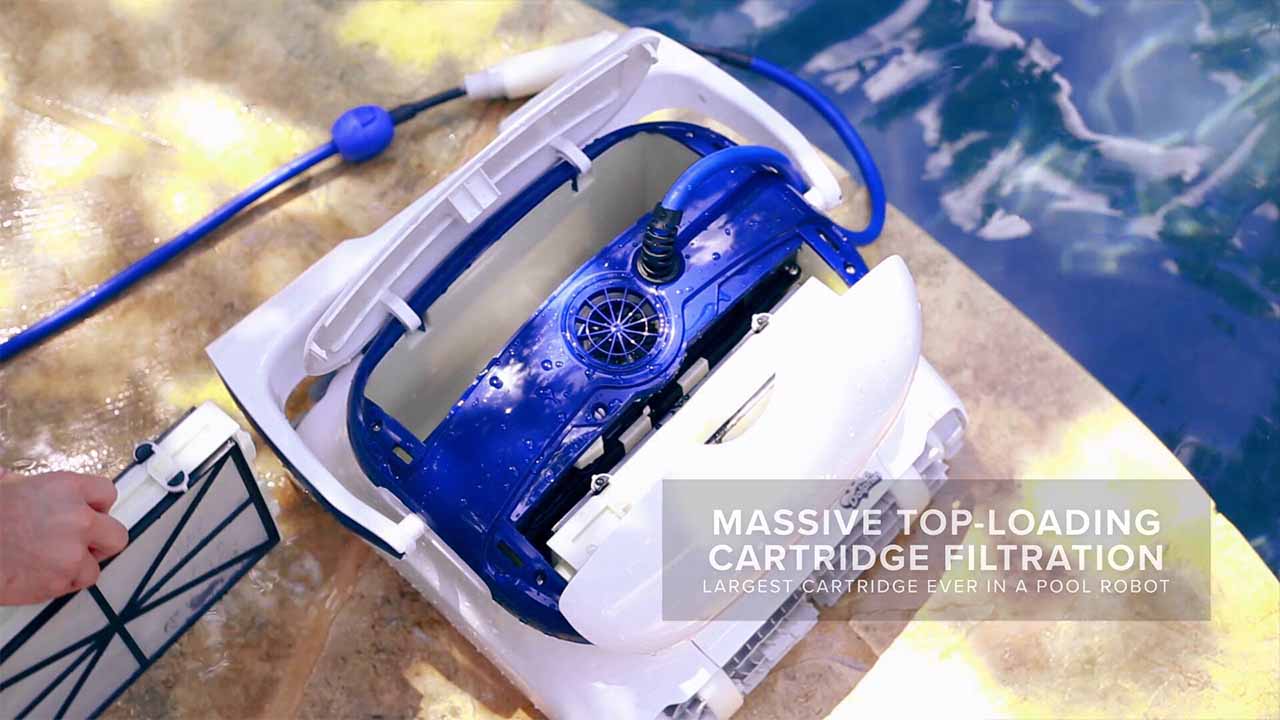
Leaf bag and NanoFilters in one box
Natural pools are planted pools, and planting sheds. When reeds die back and leaves blow in, the Premier's oversized leaf bag takes the bulk; when the water settles, its NanoFilters take the silt. Both are included, and changing over is a tool-free, top-load job. There is nothing to connect: a timer on the power supply repeats the cycle daily, every 2 days or every 3 days, which covers the frequent schedule biofilm demands. Two scrubbing brushes and two ProLine motors rated at 4,500 GPH work floor, walls and waterline in pools up to 50 ft.

$1799 $1599 SALE Save $200
Temporarily out of stock
Full NanoFilter panel set, mid-range price
The Quantum brings a full set of NanoFilter panels and fits them in an XXL MaxBin, more than 400 square inches of filter, so fine sediment has room before the basket needs a rinse. Dual HyperBrushes spin at twice the speed of standard brushes, useful on slick film, and the 2-hour cycle is short enough to run often. One caution is specific to natural pools: the Quantum is built to climb onto sun shelves, ledges and stairs. Where a shallow shelf leads toward planting, that reach is a reason to settle containment with the builder first.

$1299 $1049 SALE Save $250
Temporarily out of stock
For swimming zones up to 33 ft
Many natural pools have a modest swimming zone, and a 50 ft robot is surplus there. The Cayman's 33 ft rating covers them, and its 14.6 lb weight, the least of these four, helps when the routine includes lifting it out and washing it down. Its timer runs every day, the one setting it has, and a daily 2-hour cycle on floor and walls keeps biofilm from getting established. Be clear about two things: NanoFilter panels are an optional add-on that silty water will call for, and this robot stops below the waterline.
The criteria
Gravel, planting substrate and root mats can jam an intake and get dragged into the swimming area. If the two zones are divided only by a wall that stops below the surface, any wall-climbing robot may be able to cross it. Ask the builder how to keep the robot contained.
The debris here is mostly fine: silt, decayed plant matter, settled algae. Standard filters pass much of it back into the water. NanoFilters come with the Sigma and the Premier, and as a full panel set with the Quantum. On the Cayman they are an optional add-on.
Without sanitizer, a slick layer forms on every submerged surface, and suction alone slides over it. Active scrubbing breaks it loose so the filter can take it. More brush contact per pass is the engineering argument for a four-brush robot in this water.
Biofilm grows back quickly, so several short scheduled cycles a week beat one long clean. Look for a timer or app schedule you will leave running, and a filter you can rinse fast, because fine media load up quickly in water like this.
On paper
| Specification | Dolphin Sigma | Dolphin Premier | Dolphin Quantum | Dolphin Cayman |
|---|---|---|---|---|
| Price today | $2349 | $1949 | $1599 | $1049 |
| Pool type | In-ground | In-ground | In-ground | In-ground and above-ground |
| Pool length | Up to 50 ft | Up to 50 ft | Up to 50 ft | Up to 33 ft |
| Cleans | Floor, walls and waterline | Floor, walls and waterline | Floor, walls, waterline, sun shelves and stairs | Floor and walls |
| Cable | 55 ft with 360° anti-tangle swivel | 55 ft with 360° anti-tangle swivel | 55 ft with anti-tangle swivel | 50 ft |
| Filtration | NanoFilters and standard filter cartridges | Multi-Media: NanoFilters, oversized leaf bag and standard fine filters | XXL MaxBin basket with standard and NanoFilter panels | MaxBin basket with fine panels; NanoFilter panels optional |
| Robot weight | 24.6 lb | 20.3 lb | 18.3 lb | 14.6 lb |
| Warranty | 3 years | 3 years | 2 years | 2 years |
Walk the pool before you buy. A robot suits the part of a natural pool that looks like a conventional one: a smooth liner or a concrete shell, with defined walls and no loose material. Vinyl liner, and concrete or gunite, are on the published surface lists for these robots. EPDM rubber is not listed for any of them, so if that is your liner, ask the builder and watch the first cycles for grip.
Keep the robot away from everything else:
The point of a natural pool is that nothing chemical enters it. A robot that has worked in a chlorinated pool carries residue in its filter media, brushes and housing. Rinse it thoroughly with fresh water, inside and out, wash the filters separately, and let it drain before its first cycle. Do the same if it has been stored beside pool chemicals.
After each cycle, empty the filter promptly. Sediment and plant matter left in a wet basket break down fast. Small pond life can end up inside as well, so look before you hose it out.
A robot does not make a natural pool work. Clarity depends on the regeneration zone, circulation and nutrient balance, and a robot changes none of them. If the water turns green or cloudy, the cause is biological and the fix is the builder's.
Plan around its limits too. These pools are often unheated, and each manual gives the water conditions the robot is designed for, so check that range against your pool. No robot here cleans gravel, skims the surface or replaces cutting back plants in fall. Think of it as a floor and wall brush with a very fine filter, used often.
Owners ask
None of the robots in this guide is published as approved for them, and we will not claim otherwise. That is why our answer on the best robotic pool cleaner for natural pools is limited to the lined swimming zone. Some builders name a cleaner for their own systems, so ask yours first.
It scrubs and collects much of it from the floor and walls each cycle, which is why brush count and frequent runs matter. It will not stop the film returning, because there is no sanitizer in the water. Expect several cycles a week, and hand-brush the corners and steps a robot misses.
A robot takes in whatever is small enough to pass its intake, so small animals on the floor of the swimming zone can end up in the filter. Run it only in the swimming zone, check the filter soon after each cycle, and ask your builder whether some weeks of the year are best avoided.
In most cases, yes. The typical load is silt and fine organic sediment, which standard filters can let through. NanoFilters are included with the Sigma and the Premier, the Quantum comes with a full set of NanoFilter panels, and the Cayman takes them as an optional add-on. Rinse them often.
The verdict
First ask the builder whether a robot may run in your swimming zone at all. If yes, size it: up to 33 ft, the Cayman with NanoFilter panels; larger, one of the three 50 ft robots. Choose the Sigma when fine sediment and wall film are the main load, the Premier when leaves are, the Quantum when price decides. Then set a boundary, wash the robot, and run it often.
Keep reading