


Dolphin Sigma
$2999 $2349 SALE Save $650
Temporarily out of stock


By pool type and installation
Top pick: Dolphin Sigma
$2349 today · Free shipping
Every robot here is built for normal chlorine levels, so the choice comes down to pool size, debris and how you treat the machine on shock day.
The short answer
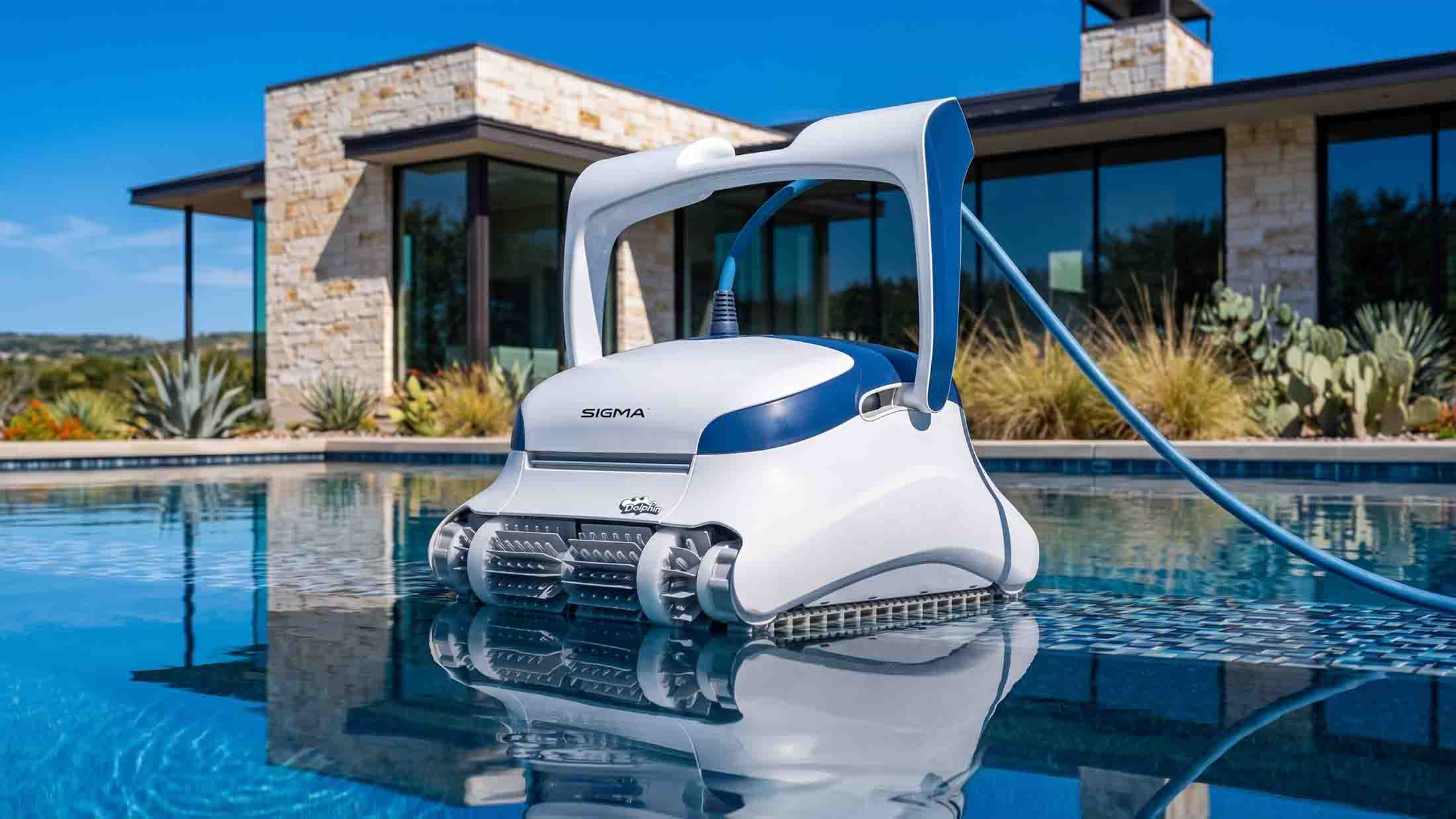
For a chlorinated in-ground pool up to 50 ft, Dolphin Sigma is the top pick: NanoFilters described as filtering to 2 microns, quad scrubbing brushes and a 3-year warranty. Choose the Premier if you want a timer on the power supply and a leaf bag in the box instead of phone control. Whichever you buy, lift it out before you shock.
Chlorine is the default. Tablets in a feeder, liquid poured at dusk, cal-hypo broadcast on a Saturday: whichever you use, the best robotic pool cleaner for chlorine pools is not a special model, because every Dolphin in this guide is built for water held at normal chlorine levels.
What chlorine changes is how you handle the machine. A robot left in the pool through a shock treatment sits in oxidizer far above the everyday range, and that ages brushes, seals and plastics. This page ranks four robots by what actually separates them, which is pool size, debris and filtration, and it sets out the routine that keeps any of them healthy in chlorinated water.
The ranking
$2999 $2349 SALE Save $650
Temporarily out of stock
Finest filtration and the most scrubbing
Chlorine works hardest on what a filter misses. The Sigma ships with NanoFilters described as filtering down to 2 microns, so fine organic debris leaves the pool inside the robot. Quad scrubbing brushes work the floor, walls and waterline, and three commercial-grade ProLine motors move 4,500 GPH.
The app has a practical use here. Its weekly scheduler sets cleaning by day and time, so cycles stay clear of the evening you dose, and a filter alert says when the cartridges need rinsing. Brushes and plastics age in any chlorinated pool, which is where a 3-year warranty counts.

$2499 $1949 SALE Save $550
Temporarily out of stock
Timer on the power supply, Multi-Media filters
The Premier suits the owner who wants the routine to run without a phone. Its weekly timer, set on the power supply, repeats every day, every 2 days or every 3 days. Multi-Media filtration puts NanoFilters, an oversized leaf bag and standard fine filters in the box. That range fits a pool where spring means pollen and fall means leaves, both of which eat chlorine while they sit. Dual scrubbing brushes and dual ProLine motors at 4,500 GPH cover floor, walls and waterline in a 3-hour cycle, backed by a 3-year warranty.

$1799 $1599 SALE Save $200
Temporarily out of stock
Shortest cycle for a 50 ft chlorine pool
The Quantum cleans a pool up to 50 ft in 2 hours, the shortest cycle of the three 50 ft robots here. In a chlorine pool that is useful arithmetic: a morning cycle is finished and the basket rinsed long before an evening dose. Its XXL MaxBin puts more than 400 square inches of filter area behind a one-click top lid, and a full set of NanoFilter panels is included. It is also the one pick whose cleaning coverage lists sun shelves, Baja ledges and stairs. It is the lowest-priced 50 ft robot in this guide.

$1299 $1049 SALE Save $250
Temporarily out of stock
Right-sized for chlorine pools up to 33 ft
A 50 ft robot is more machine than a 28 ft pool needs. The Cayman is rated for pools up to 33 ft, and at 14.6 lb it is the lightest pick here, which matters when the rule is out of the water before every shock. Its MaxBin basket is 50% larger than standard Dolphin filters and empties through a top hatch with one tab. A single HyperBrush and dual 24-volt DC motors moving over 4,000 GPH handle floor and walls in 2 hours. The timer has one setting, every day, which suits a small chlorinated pool with daily swimmers.
The criteria
No robot is meant to sit in shock-level chlorine. The real question is whether you will lift yours out before a heavy dose and leave it out until the test kit reads normal. A lighter robot makes that habit easier to keep.
Chlorine is used up by whatever organic matter is in the water: pollen, dead algae, oils bound to dust. A fine filter takes that material out of the pool. NanoFilters or NanoFilter panels come with the Sigma, the Premier and the Quantum, and are an optional add-on for the fourth pick.
Biofilm and oils cling to walls and the waterline, where circulation is weakest. Scrubbing breaks that layer up so the sanitizer in the water can reach what is underneath. Three robots in this guide scrub the waterline; one stops below it.
In-ground pools up to 50 ft belong to the three ProLine robots. The Cayman covers pools up to 33 ft, in-ground or above-ground. The Escape handles chlorine equally well in above-ground pools; it is outside this shortlist only because it has a shorter cable and no standard timer.
On paper
| Specification | Dolphin Sigma | Dolphin Premier | Dolphin Quantum | Dolphin Cayman |
|---|---|---|---|---|
| Price today | $2349 | $1949 | $1599 | $1049 |
| Pool type | In-ground | In-ground | In-ground | In-ground and above-ground |
| Pool length | Up to 50 ft | Up to 50 ft | Up to 50 ft | Up to 33 ft |
| Cleans | Floor, walls and waterline | Floor, walls and waterline | Floor, walls, waterline, sun shelves and stairs | Floor and walls |
| Cable | 55 ft with 360° anti-tangle swivel | 55 ft with 360° anti-tangle swivel | 55 ft with anti-tangle swivel | 50 ft |
| Filtration | NanoFilters and standard filter cartridges | Multi-Media: NanoFilters, oversized leaf bag and standard fine filters | XXL MaxBin basket with standard and NanoFilter panels | MaxBin basket with fine panels; NanoFilter panels optional |
| Robot weight | 24.6 lb | 20.3 lb | 18.3 lb | 14.6 lb |
| Warranty | 3 years | 3 years | 2 years | 2 years |
One habit protects a robot in a chlorine pool: take it out before you shock, and keep it out until chlorine is back in the normal range. A shock dose is many times the everyday level, and brushes, seals and tracks are exposed for as long as the robot sits in it.
The same goes for any concentrated product. Do not broadcast cal-hypo over a parked robot, and do not let trichlor tablets or a floating dispenser rest against it. The water around a dissolving tablet is far more acidic and more heavily chlorinated than the rest of the pool.
Normal chlorine is not a threat. Sustained high chlorine combined with low pH is. That mix is hard on plastics and rubber, and brushes show it first: they harden, lose grip on the wall and wear faster.
Storage matters as much as water. Rinse the robot with fresh water when it comes out for the week, dry it in the shade, and keep it and the power supply away from the shelf where you store chlorine. Fumes from stored tablets and shock are corrosive in a closed shed. For the chemistry limits of a specific model, read its manual.
A robot is not a sanitizer and does not replace one. What it does is remove material. Leaves, pollen, dead algae and wall film all consume chlorine for as long as they stay in the pool. Trap them in a filter and more of each dose is left for the water itself.
Sunlight, bather load and stabilizer level move chlorine demand far more than any cleaner, so keep testing and dosing as you do now. During an algae treatment, brush by hand as well: the robot's part is collecting the dead algae afterward, ideally with NanoFilters fitted.
Owners ask
Not at normal levels. Every robot in this guide is built for a properly chlorinated pool, which is why we can name a best robotic pool cleaner for chlorine pools on size and filtration alone. Damage comes from extremes: shock-level chlorine, low pH, or a tablet dissolving against the body.
Wait until a test shows chlorine back in the normal swimming range, not for a fixed number of hours. How long that takes depends on the dose, the sunlight and the stabilizer level. If the water is not ready for swimmers, it is not ready for the robot.
Yes, if it has a timer or an app schedule: those robots are made to stay in the water between scheduled cycles. Lift it out at least weekly to rinse the filter and before shocking or adding chemicals, and store it dry and shaded when the pool will sit unused for a long stretch.
No. The form of chlorine changes your routine, not the robot. Trichlor tablets are acidic and pull pH down over time, and cal-hypo adds calcium, so the thing to watch is water balance. Choose the robot by pool length, debris type and whether you want the waterline scrubbed.
It can make each dose go further, because debris and film that would use up chlorine end up in the filter. It will not replace sanitizer, and we would not promise a saving: sun and swimmers set most of the demand. Keep testing as usual.
The verdict
Chlorine does not pick the robot; the pool does. In-ground, up to 50 ft, with fine debris and a waterline to keep clean: the Sigma. Same pool with heavy leaves and a preference for a simple timer: the Premier. Ledges, stairs or a tighter budget: the Quantum. Up to 33 ft: the Cayman. Whatever the model, keep one rule: robot out before shock, back in when the water tests normal.
Keep reading
