


Dolphin Escape
$959 $659 SALE Save $300
Temporarily out of stock


By pool length and dimensions
Top pick: Dolphin Escape
$659 today · Free shipping
In a stock tank, a small round or a plunge pool a robot is optional, so the right one is the lightest and simplest that fits ten feet of water.
The short answer
For a 10-foot pool, the Dolphin Escape is the natural fit: the lightest robot in these guides at 14.2 lb, with the shortest cable at 40 ft and the shortest cycle at 1.5 hours. Choose the Dolphin Cayman for an in-ground plunge pool you want cleaned daily. The Dolphin Quantum only makes sense for an in-ground plunge pool with steps, a ledge and a tile line. First confirm the water is deep enough.
The best robotic pool cleaner for a 10-foot pool is the least robot that will do the job. At this size the pool is a small round above-ground model, a stock tank, a compact spool or an in-ground plunge pool, with a floor of around 80 square feet. Any robot in this guide crosses that in minutes. The problems run opposite to a big pool's: tight turns, a great deal of spare cable and, in some pools, water barely deep enough to cover the machine.
We will also say what a store usually will not. A pool this small can be kept clean with a brush and a hand vacuum in a few minutes, and many owners should stop there. A robot is worth buying when you want the floor and walls scrubbed without thinking about it, or when leaning over the edge with a pole is the chore you would pay to lose. If that is you, three robots fit. Our own flagship is not one of them.
The ranking
$959 $659 SALE Save $300
Temporarily out of stock
The natural fit at 10 ft
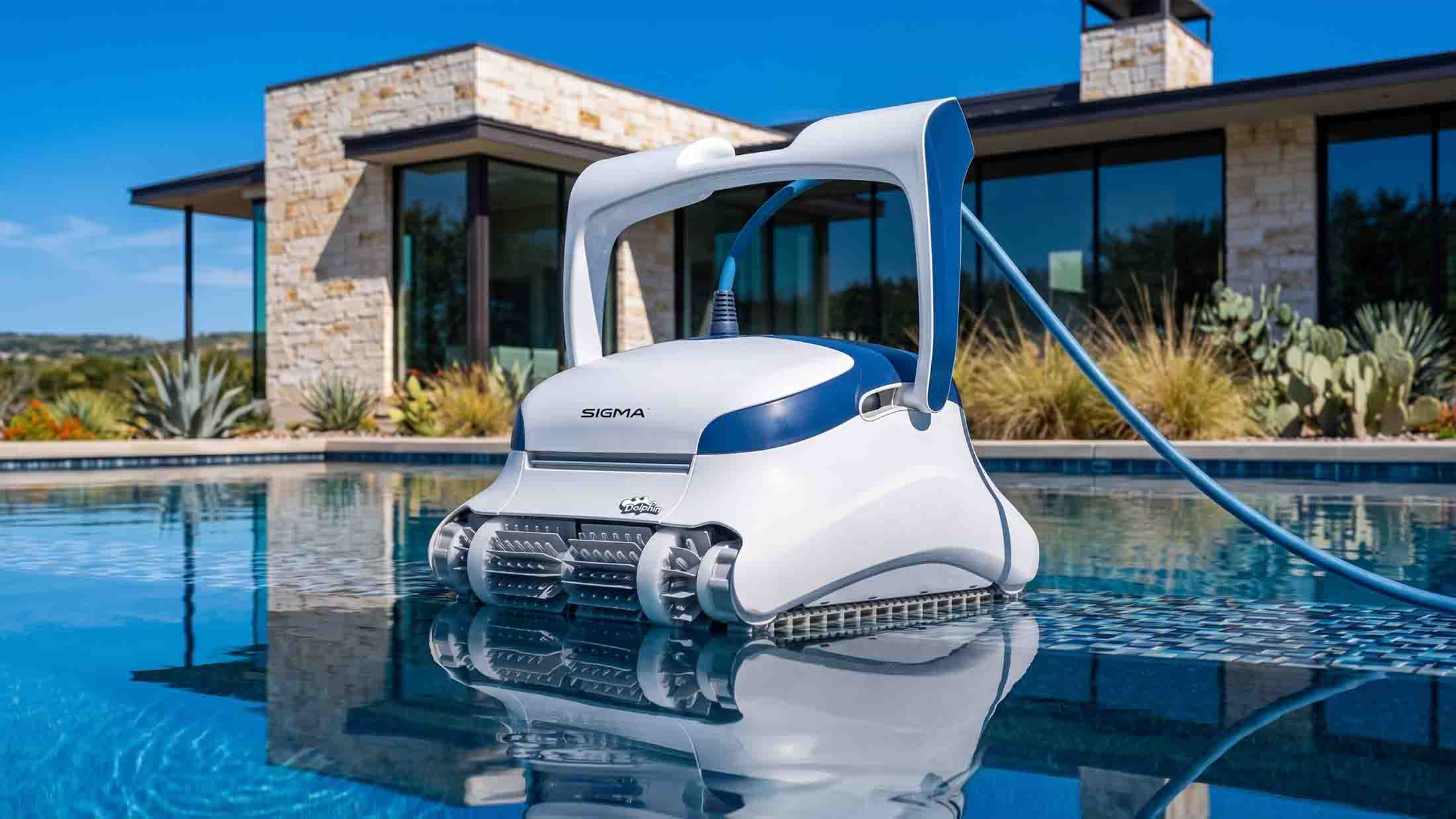
Every number that counts in a tiny pool is lowest on the Escape. It weighs 14.2 lb, so lifting it over a wall asks the least of you. Its 40 ft cable is the shortest in these guides: still far more than the pool needs, but the least to keep out of the way. Its 1.5-hour cycle is the shortest of the five, and on 80 square feet that is ample time for repeat passes over floor and walls.
It is built above-ground first, and round pools, vinyl liner and fiberglass are all on its published lists. It also carries the lowest price here, which counts when the robot itself is optional.

$1299 $1049 SALE Save $250
Temporarily out of stock
For a built-in plunge pool, cleaned daily
The Cayman is close to a twin of the first pick in the water: one HyperBrush, HyperGrip tracks, dual 24-volt DC motors, over 4,000 GPH and a MaxBin basket, at 14.6 lb. Two differences earn it second place. Its published surfaces add concrete, plaster and pebble, the finishes a built-in plunge pool usually has. And a timer on its power supply starts a cycle every day.
A plunge pool beside a patio collects dust and leaf litter daily and has little water to hide it in. A robot that runs itself each morning suits that pool better than one waiting for you to remember.

$1799 $1599 SALE Save $200
Temporarily out of stock
Only when steps, ledges and tile are the job
A robot rated for 50 ft is a strange thing to lower into a 10 ft pool, and most of the time we would talk you out of it. The exception is the designed plunge pool: in-ground, tiled at the water, with a bench along one wall and steps in a corner. There the floor is the smallest part of the cleaning.
The Quantum is the one robot in these guides whose coverage list includes stairs, sun shelves and Baja ledges along with the waterline, and its dual HyperBrushes spin at twice the speed of standard brushes against that tile. At 18.3 lb it is the lightest ProLine robot, and its 2-hour cycle is the shortest of them.
The criteria
A robot must stay fully submerged to run and to climb. Stock tanks and soft-sided 10-footers often hold about two feet of water. We do not quote a minimum depth for these robots here: check the manual for the model you choose before ordering, or ask us to confirm it.
Every lift is by hand, usually over a wall. The Escape weighs 14.2 lb, the Cayman 14.6 lb and the Quantum 18.3 lb. The heaviest of the five Dolphins in these guides adds about ten pounds to the lightest, all of it capacity a 10 ft pool cannot use.
Even the shortest cable here, 40 ft, is four times the pool's width. With a wall never more than a few feet away, the robot spends much of its cycle turning. Spare cable left in the water is what it ends up driving over.
Published surface lists cover vinyl liner, fiberglass, gunite and tile, with plaster, concrete and pebble on some models. Galvanized steel is not on any robot's list. If your pool is a bare metal stock tank, ask before you buy, not after.
On paper
| Specification | Dolphin Escape | Dolphin Cayman | Dolphin Quantum |
|---|---|---|---|
| Price today | $659 | $1049 | $1599 |
| Pool length | Up to 33 ft | Up to 33 ft | Up to 50 ft |
| Cable | 40 ft | 50 ft | 55 ft with anti-tangle swivel |
| Cycle time | 1.5 hours | 2 hours | 2 hours |
| Cleans | Floor and walls | Floor and walls | Floor, walls, waterline, sun shelves and stairs |
| Navigation | SmartNav 2.0 | SmartNav 2.0 | SmartNav 2.0 |
| Scheduling | Optional Automation Timer: every 24, 48 or 72 hours | Timer: every day | Weekly timer: every day, every 2 days or every 3 days |
| Robot weight | 14.2 lb | 14.6 lb | 18.3 lb |
| Warranty | 2 years | 2 years | 2 years |
For many 10 ft pools the honest answer is no. A wall brush and a hand vacuum do the whole pool in five to ten minutes, and a seasonal pool that is drained each fall rarely justifies a machine.
A robot starts to make sense in four cases: the pool is used daily, it sits under a tree, the owner finds reaching and bending difficult, or it is a permanent in-ground plunge pool that is meant to look finished every day. In those cases the robot is buying consistency. It scrubs the walls each cycle and filters through its own basket, which matters where the pool's pump and filter are small.
Measure the water, not the wall. A 30-inch wall holds roughly two feet of water, and the figure that matters is the depth at the shallowest part of the floor. Compare it with the minimum in the robot's manual. A robot that is not fully covered will not run properly, and no setting fixes that.
Then look at the floor. Soft-sided pools set on sand or bare ground develop wrinkles and footprints. A robot rides best on a flat liner, so smooth the floor when you fill the pool. On a pool with flexible walls, expect the floor to be the main job and wall climbing to be less predictable.
Uncoil only what the robot needs: the pool's width, its depth and the setback to the power supply that the manual requires. Leave the rest loosely coiled beside the supply, never in the water.
Neither the Escape nor the Cayman has a swivel on its cable, and a small pool means constant turning, so twists build up. When the cable starts to kink or coil on the surface, unplug it and lay it out straight on the deck or lawn to release them.
Owners ask
Often, yes. The pool can be brushed and hand-vacuumed faster than the robot's cycle runs. It stops being overkill when the pool is cleaned daily, sits under trees, or belongs to someone who would rather not handle a pole. Then the lightest robot that fits, the Escape, is a reasonable purchase.
Possibly, with two checks. First, depth: most stock tanks hold about two feet of water, so compare that with the minimum in the manual. Second, surface: galvanized steel is not on the published surface list of any robot in these guides, so we cannot promise wall climbing or fit. Send us the tank's dimensions and we will tell you straight whether to try it.
The pool type is right for the Escape, which is rated for above-ground pools and lists vinyl liner among its surfaces. The limits are depth and wall stiffness. Many 10 ft soft-sided pools are shallow, so check the manual's minimum, and an inflatable-ring wall gives a robot little to climb. Expect a clean floor first and treat the walls as a bonus.
A robot on a timer, such as the Cayman, is made to stay in the water between scheduled cycles. With a robot you start by hand there is little reason to: in a pool this small it takes up swimming room. Lift it out, rinse it and store it in the shade. Either way, take it out before shocking the pool or adding chemicals.
The verdict
Decide first whether you want a robot at all; a brush and a hand vacuum are a fair answer at this size. If you do, check depth against the manual, then buy the lightest robot that matches the pool: the Escape for above-ground and most small pools, the Cayman for an in-ground plunge pool cleaned daily, the Quantum only when steps, a ledge and tile are the real work. Do not pay for a 50 ft machine to clean 80 square feet. If the depth is borderline, ask a Dolphin expert.
Keep reading
