Dolphin Sigma
$2999 $2349 SALE Save $650
Temporarily out of stock


By steps, ledges and tricky features
Top pick: Dolphin Sigma
$2349 today · Free shipping
A curved wall never lets a robot drive straight or turn both ways equally. That is a cable problem and a navigation problem, and the picks are ranked on both.
The short answer
For curved in-ground walls, the Dolphin Sigma leads: its gyroscope holds a heading where no wall runs straight, and its 360-degree swivel releases the twist that constant one-way turning puts into a cable. For a round or oval above-ground pool, skip it and choose the Cayman, which is rated for both pool types up to 33 ft.
Straight walls are easy on a robot. It drives to the wall, climbs, comes down, turns, and the next lane runs parallel to the last. Curved walls take that away. In a kidney, freeform, oval or round pool, the robot meets the wall at a slant, and the turns it makes to follow the shape tend to go the same way, lap after lap.
Those two facts are what the best robotic pool cleaner for curved walls has to handle. Slanted approaches test traction and the robot's sense of direction. Same-direction turning winds the cable like an old telephone cord. So the ranking favors a gyroscope, a swivel and good tracks: the Sigma, then the Premier and the Quantum. Round above-ground pools are a separate case with their own answer.
The ranking
$2999 $2349 SALE Save $650
Temporarily out of stock
Holds a heading where nothing is straight
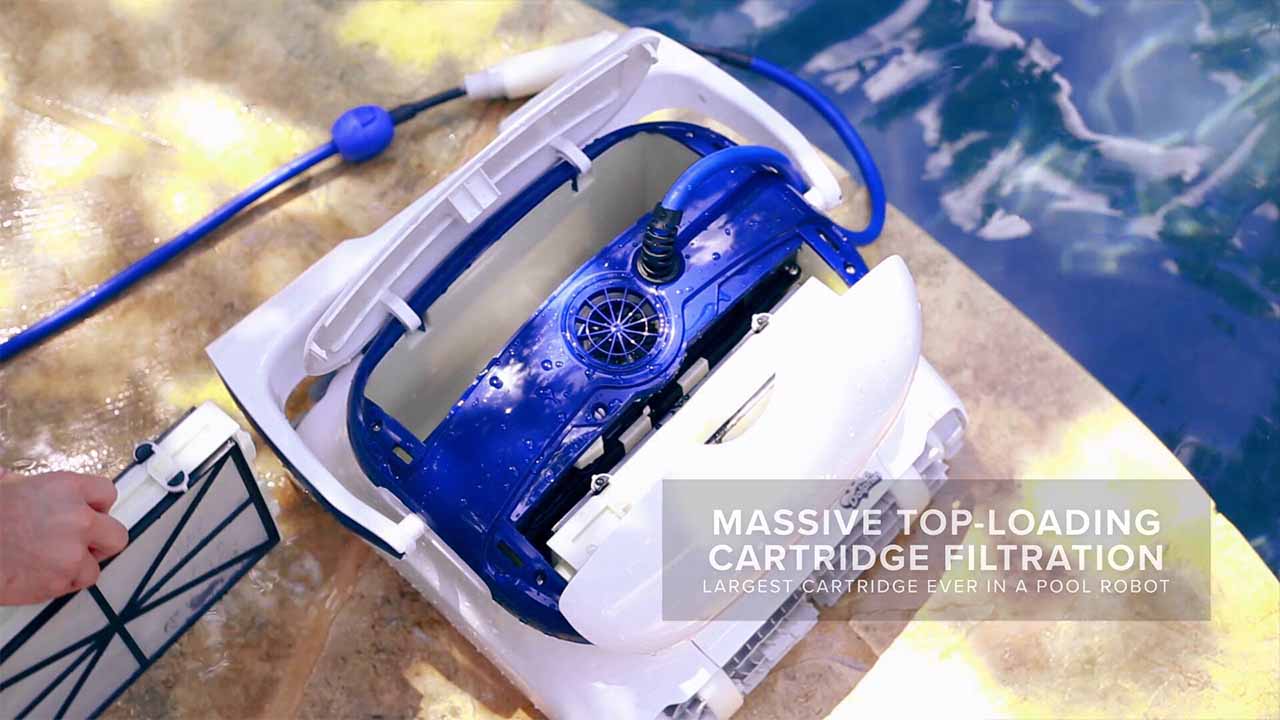
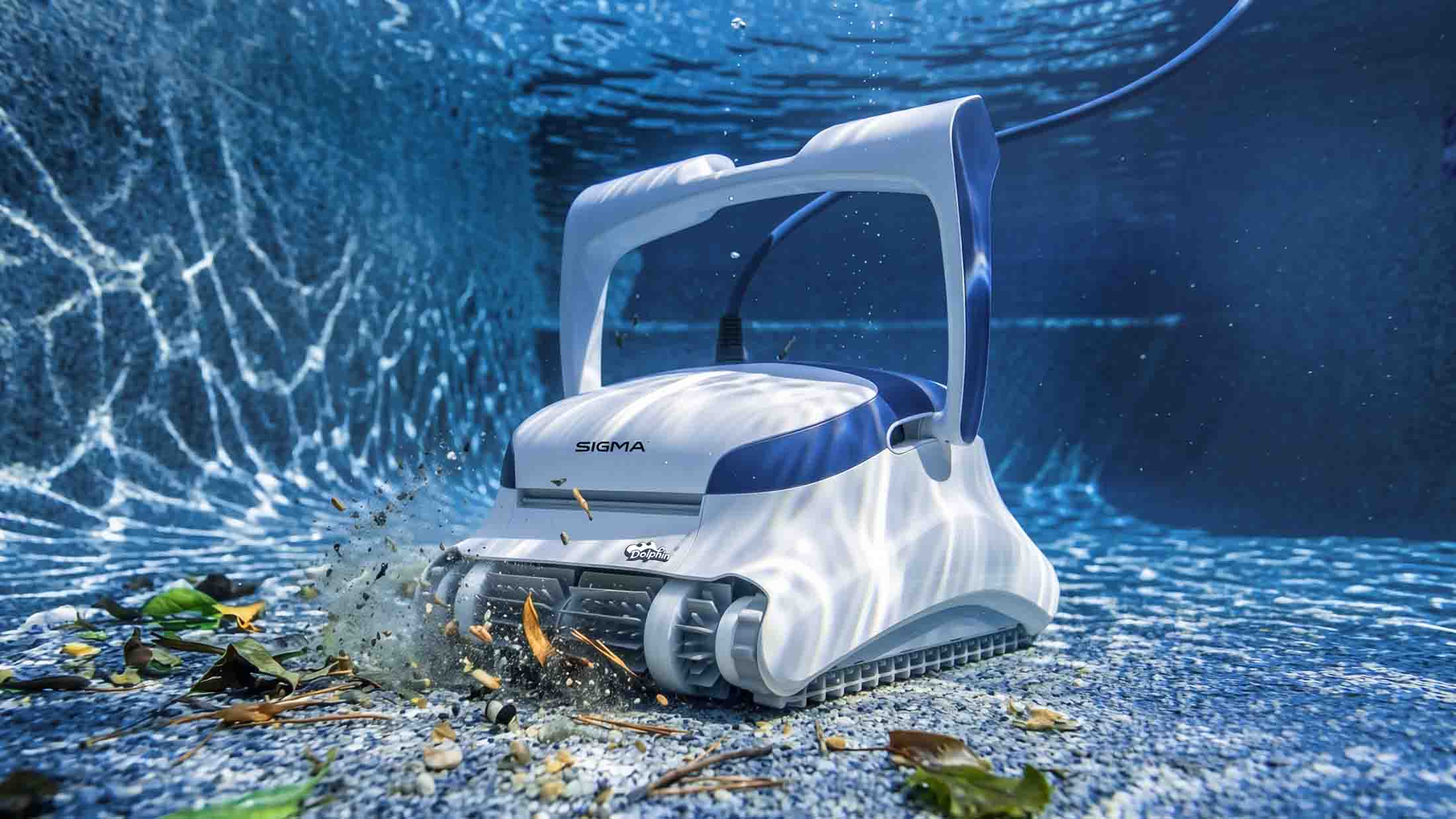
In a curved in-ground pool the Sigma has the two parts that matter. SmartNav 3.0 with an onboard gyroscope tracks the robot's orientation, so a slanted arrival at a curved wall is something it can register and correct, and coverage does not depend on finding a straight edge. The 55 ft cable has a 360-degree anti-tangle swivel for the one-way turning that kidney and oval pools force. Three commercial-grade ProLine motors carry it up to the waterline, where quad scrubbing brushes follow the tile line around the bend.

$2499 $1949 SALE Save $550
Temporarily out of stock
Swivel cable, three hours to find every lobe
The Premier does without the gyroscope and leans on its other strengths. Its 55 ft cable carries the same 360-degree anti-tangle swivel, so one-way turning is handled as well as on the Sigma. SmartNav 2.0 scanning works its way around lobes and inside bends, and a three-hour cycle, the longest of the four, gives it time to reach the far end of a big freeform shape. Its published shapes include oval, freeform and L-shaped, and Multi-Media filtration handles whatever the planting around a freeform pool drops in.

$1799 $1599 SALE Save $200
Temporarily out of stock
Curves that come with shelves and steps
Curved pools rarely stop at curved walls. Freeform designs usually add a sun shelf, a wraparound step or a bench, and the Quantum is the only pick whose published coverage includes sun shelves, Baja ledges and stairs along with floor, walls and waterline. Its 55 ft cable has an anti-tangle swivel, SmartNav 2.0 senses ladders and drains, and continuous HyperGrip rubber tracks hold on a slanted climb. Among the 50 ft robots it is the lowest priced, and at 18.3 lb the lightest to lift out.

$1299 $1049 SALE Save $250
Temporarily out of stock
The pick for round and oval pools to 33 ft
The Cayman is here for the curves the other three are not built for. Its rating covers in-ground and above-ground pools up to 33 ft, its published shapes include oval and freeform, and at 14.6 lb it is easy to lift over a top rail. One fast-spinning HyperBrush cleans the floor and walls in two hours. Its 50 ft cable has no swivel, and a round pool turns a robot one way all cycle, so lay the cable out straight before each run and untwist it when coils show.
The criteria
Following a curve means turning the same direction again and again. Each turn adds twist to the cable, and with nowhere to go it builds into coils that shorten the cable and pull the robot off the wall. A swivel releases it, and three of the four picks have one: the Sigma, Premier and Quantum.
On a curve the robot arrives at an angle, so one track reaches the wall first and the body wants to slew. Grip and a sense of orientation decide whether it climbs cleanly. All four picks use HyperGrip tracks. The Sigma adds a gyroscope.
A rectangle hands a robot its pattern. A freeform pool does not: lobes, necks and inside bends have to be found, and that takes time. Shorter cycles leave less of it for the far lobe, which favors the Premier at three hours and the Sigma at 2.5.
In-ground curves are rigid. Above-ground curves are a thin steel or resin wall with a liner, or a soft-sided wall, and they give under a climbing robot. Expect the floor and wall base to be cleaned well. Height on the wall depends on how firm it is.
On paper
| Specification | Dolphin Sigma | Dolphin Premier | Dolphin Quantum | Dolphin Cayman |
|---|---|---|---|---|
| Price today | $2349 | $1949 | $1599 | $1049 |
| Cleans | Floor, walls and waterline | Floor, walls and waterline | Floor, walls, waterline, sun shelves and stairs | Floor and walls |
| Traction | HyperGrip tracks | HyperGrip tracks | HyperGrip tracks | HyperGrip tracks |
| Navigation | SmartNav 3.0 with gyroscope | SmartNav 2.0 | SmartNav 2.0 | SmartNav 2.0 |
| Cable | 55 ft with 360° anti-tangle swivel | 55 ft with 360° anti-tangle swivel | 55 ft with anti-tangle swivel | 50 ft |
| Robot weight | 24.6 lb | 20.3 lb | 18.3 lb | 14.6 lb |
| Warranty | 3 years | 3 years | 2 years | 2 years |
Picture a robot circling a round pool clockwise. Every lap, the robot rotates once relative to its power supply and the cable takes up one full turn. Ten laps, ten turns. The cable shortens into coils and starts steering the robot. In a rectangle the left and right turns roughly cancel. On a curve they do not.
A swivel is a rotating coupling on the cable that lets those turns spin out as they form. Without one, the twist is removed by hand: unplug, lay the cable straight on the deck and turn out the coils from the robot end. Done every few cycles, that keeps a plain cable working well in a round pool.
Most curved walls in backyards belong to round and oval above-ground pools, and they call for a different robot from a kidney-shaped gunite pool. The three 50 ft robots on this page are in-ground machines and are not rated for that kind of pool. The Cayman is rated for both. The Escape, the fifth Dolphin in these guides, is built around above-ground pools and is also a sound choice for a round one. It has a 40 ft cable against the Cayman's 50 ft, and neither has a swivel.
Once a round pool passes about 24 ft across, check the cable run from the power supply's position before settling on a 40 ft cable. The Cayman's extra 10 ft is the safer margin.
On a curved pool, where the cable enters the water matters more than on a rectangle. Put the power supply near the middle of the pool's long side, set back from the edge by the distance your manual gives. On a kidney, that is the inside of the bend, where both lobes are about the same distance away. Put only as much cable in the water as the farthest point needs, and leave the rest on the deck. Spare cable floating in a curved pool finds the robot sooner or later.
Owners ask
Yes. Following a curve turns the robot the same way repeatedly, and each turn adds twist that a rectangle would cancel out. A swivel, fitted to the Sigma, Premier and Quantum, releases it. With a plain cable, laying it out straight every few cycles does the same job by hand.
The Cayman cleans floor and walls and is rated for above-ground pools up to 33 ft. Climbing height comes down to the wall. A rigid steel wall filled to the normal line gives it something to push against. A soft-sided wall flexes, so the robot may clean the base and go no higher.
No. Kidney pools fall under freeform, a shape all four picks publish. What a kidney needs is a cable that will not wind up, since the bend keeps the robot turning one way, and enough cycle time for both lobes. Over 33 ft, that points to the Sigma or the Premier.
It is worth the most there. With no straight wall to line up on, a robot depends on its own sense of direction, and the Sigma's gyroscope supplies it. In a small oval the gain is modest. Check the live price on each card and weigh it against the size of your pool.
Two parts. A swivel, or disciplined cable handling, because curves wind cables. And navigation that does not rely on parallel lanes, because curves do not offer any. Flow, brushes and filters matter as in any pool, but they are not what a curve changes.
The verdict
Sort by construction first, curve second. Rigid in-ground curves up to 50 ft: buy a swivel, and add the gyroscope if the shape is large or irregular. That is the Sigma, with the Premier and Quantum close behind for simpler ovals. Round or oval above-ground pool, or any curved pool of 33 ft or less on a budget: the Cayman, with the cable laid straight.
Keep reading